
You Owe God $10 Billion
Posted on October 31, 2016 Leave a Comment

Image from Mission Church
Jesus is a master storyteller. Much of his teaching about God and the kingdom of heaven comes in the form of parables—little stories that pack a big punch. In Matthew chapter 18, we encounter one such parable on the subject of forgiveness.
[21] Peter came up and said to him, “Lord, how often will my brother sin against me, and I forgive him? As many as seven times?” [22] Jesus said to him, “I do not say to you seven times, but seventy-seven times.”
Peter’s question is a legitimate one. When we have a person in our life that consistently lets us down, breaks our trust, and sins against us, how often should we forgive them? Something like seven times?
Jesus responds by saying that we must forgive them 77 times, which is really just another way of saying you have to keep forgiving them over and over. Expecting Peter and the others to be in shock at this, Jesus tells a story to help us understand why his answer makes sense.
In Debt to God
The story begins:
[23] “Therefore the kingdom of heaven may be compared to a king who wished to settle accounts with his servants. [24] When he began to settle, one was brought to him who owed him ten thousand talents. [25] And since he could not pay, his master ordered him to be sold, with his wife and children and all that he had, and payment to be made. [26] So the servant fell on his knees, imploring him, ‘Have patience with me, and I will pay you everything.’ [27] And out of pity for him, the master of that servant released him and forgave him the debt.
The king in the story represents God, and the servant represents you and I. The story starts by establishing that we are in debt to God. Jesus uses the figure of ten thousand talents. But how much exactly is that? A talent was a unit of money that was worth about 20 year’s wages. I’m not great at math, but it works out something like this:
- If one year’s wages is roughly $50,000, then one talent is worth $1 million.
- If we owe 10,000 talents at $1 million each, we owe $10 billion.
Ten billion dollars is a figure none of us can really wrap our heads around. It’s borderline beyond our ability to comprehend. And that’s exactly the point. When it comes to our sins against God, we might as well owe him $10 billion. Our debt it massive. It’s incomprehensible! We could not pay it in a thousand years. It is far larger than we usually consider it to be.
Most of us will admit that we are in debt to God because of our sin. But most of us also minimize exactly how bad our sin really is. We figure that overall we are decent people who stumble here and there. Certainly, we need God’s grace to merit salvation, but it’s more like asking for a favour from a friend than going to a banker to forgive a $10 billion debt.
This is something we absolutely have to let sink in. Our sin is grievous. It is reprehensible, disgusting, wicked, deplorable. It is stacked a mile high and wide. Our sin against God, even our little pet sins that don’t seem so bad, are worse than they seem. Every sin we commit is taking the gifts that God has given us to use for his glory and the good of others and instead using them against him and for our own selfish interests. The mouth he gave for us to praise him with we use to deride others. The hands he gave us to serve with we use to steal and abuse. The eyes he gave us to see his wonders with we use to lust. The mind he gave us to meditate on him we use to devise ways to sin and keep anyone from finding out. It’s like a dad who bought his 16 year-old a new pickup truck for his birthday, only to come home from work the next day and discover his most valuable belongings have been packed up in it and carried off.
Only when we see our sin has being horrendous and insurmountable will we, like the servant in the story, cry out for mercy. And God, being a merciful God, grants it! Ten billion? Don’t worry about it! I’ll cover the difference. What an amazing God!
But the story isn’t finished yet…
How Shall We Then Live?
[28] But when that same servant went out, he found one of his fellow servants who owed him a hundred denarii, and seizing him, he began to choke him, saying, ‘Pay what you owe.’ [29] So his fellow servant fell down and pleaded with him, ‘Have patience with me, and I will pay you.’ [30] He refused and went and put him in prison until he should pay the debt.
The servant who was forgiven $10 billion promptly goes out and refuses to forgive the man who owes him less. The amount is a hundred denarii. A denarii was worth one day’s wage for a labourer. If we follow the same values as before, it looks like this:
- At $50,000 per year, one day’s wage is worth $192. Let’s round it to $200 for the sake of ease.
- A hundred denarii, at $200 apiece, would total $20,000.
So the servant who was forgiven $10 billion refuses to forgive them man who owes him $20,000. Now, don’t misunderstand—twenty thousand dollars is a substantial amount of money. To lose out on that would hurt. It would be a significant loss. And again, that’s just the point. Jesus, in saying we must forgive 77 times is not trying to say that the sins committed against us are not a big deal. They are a big deal. They are $20,000 worth of a big deal. It would be natural for us to say, “Hey! You expect me to let you off the hook twenty thousand again? This is the eighth time! Seven was enough.” No sane person would just let that roll off their back.
Unless, that is, they had just walked away from being forgiven a debt themselves of $10 billion. A person who has been released from a ten billion dollar debt can let go of a $20,000 a whole lot easier than a person who doesn’t know what it’s like to be forgiven that amount. And this is precisely what Jesus wants us to learn from the story.
Go Forgive Because You’ve Been Forgiven
Jesus concludes:
[31] When his fellow servants saw what had taken place, they were greatly distressed, and they went and reported to their master all that had taken place. [32] Then his master summoned him and said to him, ‘You wicked servant! I forgave you all that debt because you pleaded with me. [33] And should not you have had mercy on your fellow servant, as I had mercy on you?’ [34] And in anger his master delivered him to the jailers, until he should pay all his debt. [35] So also my heavenly Father will do to every one of you, if you do not forgive your brother from your heart.”
This pointed ending sums up the matter perfectly. God demands that we forgive others, and gives us the power to do so by helping us to remember just how much we ourselves have been forgiven. We can release others from our debt when we realize just how much more God has released us from his debt. In other words, the key to being a person who can forgive those who wrong you is to realize that you once owed God $10 billion.
If you are someone who is holding a grudge, or is unable to forgive someone who has sinned against you from your heart, then here is what you need to do: rather than rehashing what that person has done to you and just how awful it is, meditate on what you have done to God and just how much more awful that is. And do this until you feel like you owe God $10 billion, and then remind yourself that Jesus paid that fine in full on your behalf and you walked out of the courtroom of God, not as a debtor of $10 billion, but as a free person with an account balance that is all squared up.
If you realize this and ponder this until you really feel it, forgiving others won’t be nearly as hard a thing to do as you might think.
Why It’s Stupid to Pit Paul Against Jesus
Posted on October 19, 2016 Leave a Comment

The debates among scholars are endless. One of the more prominent debates over the last few decades has been over whether the apostle Paul understood the Christian faith the same way Jesus did. It is suggested by some that the content of Paul’s epistles show that he formed a different picture of what Jesus came to accomplish than what Christ himself pictured. Jesus, it appears, was all about the kingdom of God. He spoke of restoring God’s kingdom to earth, of serving the poor, and making love the central goal in life. Paul, on the other hand, seems obsessed with sin and the concept of justification by faith. Think of it something like this: Jesus is mainly about the here and now, creating people who reflect God’s values of justice, care for the oppressed, and loving community. Paul, however, is mainly about the afterlife, believing in Jesus as your free ticket to heaven, fearing eternal damnation, and nit-picking over details of sin.
It gets even more complicated than that. I have heard people pit Paul against the apostle John, saying that what we need more of in this day is less of Paul’s hellfire and brimstone and more of John’s message of love. And not that long ago I heard someone pitting Luke against Paul, saying that while Paul seems bent on highlighting the Christian faith as mainly about deliverance from sin and hell, the book of Acts (written by Luke) contains the earliest sermons of the church, which hardly mention sin or hell at all but mostly highlight the resurrection of Christ.
While I greatly appreciate that there are men and women far more intelligent than I discussing these matters—and there definitely is value in such conversations—it really isn’t as complicated as it is made out to be. I have a simple observation to make that ought to automatically quell a good half of the debate. Yes, there are still finer points to work out. But there is a base that we ought to be operating from, and this base should give us a significant framework for understanding these issues and help us better come to a common consensus.
What We All Need to Keep In Mind
The thing we need to remember is that these men all knew each other personally. More than that, they approved of each other. Jesus, Paul, John, Luke, and other New Testament contributors were all part of the same network of people who were on a common mission with a common vision. A basic reading of the Bible will bring you to this conclusion.
- Paul was personally commissioned by Jesus to be an apostle and witness for him (Acts 9:1-22).
- Paul met with James (Jesus’ brother, and author of the NT book of James), Peter, and John specifically for the purpose of sharing the content of his theology and preaching, after which all agreed they were on the same team (Galatians 2:1-10).
- Luke was one of Paul’s ministry companions (2 Timothy 4:11, Philemon 1:24).
- Peter calls Paul his “beloved brother” and his writings “Scripture” (2 Peter 3:15-16).
- Peter, John, and Matthew were all part of the 12 disciples together, personally trained under Jesus himself (Mark 3:16-19).
All of these men were familiar with one another and fully supported one another—which really is saying something, considering that all of them harshly denounce false teachers and would never consider partnering with one in ministry. Instead, what we see is that they seem to view themselves as brothers in a common faith, an extension of the faith Jesus came to establish.
Wouldn’t it make more sense that if Paul was highjacking the kingdom of God concept that Jesus came to bring, and distorted it into something else, that guys like Peter and John would have been all over it? They were the most immediate bridge between Paul and Jesus. Either one of them could have easily stepped in and said, “Whoa, Paul! You’ve got this all wrong. You’re misrepresenting what Jesus was all about. Listen, we were there before you, man. We heard it straight from his mouth. Let’s sit down and sort this out.” But do you see this at all? No. Instead, you see John and Peter approving of Paul’s message in Galatians 2, calling him a “brother”, and saying that his writings are Scripture.
There’s Stuff to Discuss, But Not Divide Over
I understand that there are themes that sometimes seem hard to reconcile with each other’s teachings, but we should not consider that the solution to those challenges is to assume some kind of disharmony among the New Testament authors. Rather, we should keep in mind that they all seemed to be part of a large network of Christian witness that had a central, unifying theme, while each individual author contributed their own flavour and perspective to that unifying theme. In other words, we should give these guys the benefit of the doubt, that if they were all sitting at a table together discussing theology, they would believe themselves to be sitting amongst brothers and having a good, hearty discussion that in the end would conclude with prayer, laughter, handshakes and hugs.
I believe it is the epitome of arrogance for us “sophisticated” modern elites to look back on the message of the New Testament and begin to sow division where there really is none. Pride is what drives us to think that Jesus would take issue with Paul, or Luke with Paul, or John with Peter, or any combination of the like. The Bible is a harmonized unit, and has been recognized as such by believers for 2,000 years. Yes, it is not without its challenging passages. Yes, there are things that are hard to reconcile. But overall there is no doubt that the Christian faith was clearly understood and passed on by these men, and though it has different emphases from each, there is a central cluster of truths at its core which we need not question, but only recognize, believe, and embrace.
When Your Family Doesn’t Support Your Faith
Posted on October 14, 2016 12 Comments

You’re a brand new Christian. You’ve made the decision to follow Christ, to call on him as your Saviour and Lord, and start a new life built on your faith in Jesus. This journey will bring all sorts of experiences: some of them wonderful, some of them confusing, some of them exciting, and some of them challenging. Nevertheless, you are prepared to move forward and find out where this journey with Jesus will take you.
But there’s just one problem, and it’s not a small one.
Your family doesn’t approve.
People you have grown up with all your life don’t understand this new chapter in your life. Those you have leaned on for everything think you’re making a mistake, or that you are justing going through some temporary phase, or that you’re full-blown crazy. They think you are joining a cult. Or perhaps, they are just downright hostile to the notion that you would become a Christian. Whatever the exact details look like, the point is that the people you call your family are now not as close to you as they once were….and it’s all because of a choice you felt the need to make.
Lot’s of Questions
It’s not a fun experience when there is a wedge driven between family members, and that experience is doubly painful when you believe that you are the cause of it. After all, it was your decision to become a Christian and disturb the waters of peace in the family. You might have even known ahead of time that it wouldn’t have been taken too well. Yet you chose anyways. And now the backlash has become real and painful and you’re filled with all kinds of significant questions.
- Is it worth the difficulty of standing my ground?
- Should I hide my newfound faith?
- How far do I let the fighting go before I concede to their demands?
- Why would God allow me to go through this?
- Is this whole thing my fault?
- What should I do about it?
These are legitimate questions and don’t have easy answers. Therefore I would encourage anyone who is experiencing strife in their family because of their faith to not take it lightly or try to brush it off.
Jesus Also Had Unbelieving Family
When it comes to how Jesus’ family thought about him, John 7:4 tells us that “not even his brothers believed in him”. Imagine what that would have been like for Jesus, God in the flesh, to be rejected by his own family. No doubt it hurt, but it did not throw him off of his mission to follow the will of God. The Father was first priority, and Jesus never wavered one bit, despite all the pressure that was on him.
For instance, in Mark 3:21, Jesus’ family members show up and attempt to take Jesus home with them, because they thought he “was out of his mind”. They considered him to be an embarrassment to the family. But they couldn’t have been more mistaken! Jesus was absolutely in his right mind. He was seeing things clearly and walking in obedience, bringing glory to God. Yet his family simply didn’t get it.
Some Christians will face these kinds of circumstances. Family members will think you are crazy, they will persuade you to remit your faith, and even accuse you of bringing shame on the family and being a public embarrassment. Like Jesus, do not let these accusations cause you to falter. Know the truth and walk in it, and in the meantime pray that God would open the eyes of your family to see what you see about the beauty of God.
What Jesus Has to Say
Jesus had many things to say about the relational cost that would come from following him (he certainly knew it would be an inevitable reality for some), but perhaps none address it more directly than his words in Matthew 10:34-39…
[34] “Do not think that I have come to bring peace to the earth. I have not come to bring peace, but a sword. [35] For I have come to set a man against his father, and a daughter against her mother, and a daughter-in-law against her mother-in-law. [36] And a person’s enemies will be those of his own household. [37] Whoever loves father or mother more than me is not worthy of me, and whoever loves son or daughter more than me is not worthy of me. [38] And whoever does not take his cross and follow me is not worthy of me. [39] Whoever finds his life will lose it, and whoever loses his life for my sake will find it.
Somewhat surprisingly, Jesus says he came to bring division and not peace. This should catch us off-guard. Didn’t the angel announcing Jesus’ birth say “peace on earth, and good will towards men”? Wasn’t the point of Jesus’ coming to resolve sin, bring back love, and heal humanity? So what’s all this about bringing a sword?
Don’t misunderstand: Jesus IS in the peacemaking business. But he is not into peace at any cost. He is into peace that comes from righteousness. In other words, Jesus doesn’t fight for peace at the expense of truth or through compromise. He is after the right kind of peace in the right kind of way. Not all peace is virtuous. So when Jesus says he came to bring a sword and not peace, he means that he is not advocating for a certain kind of peace.
What peace is he avoiding, and what peace is he affirming? Read the rest of the text. The kind of peace Jesus doesn’t desire is the kind that comes when people compromise the truth in order to get along. Specifically, Jesus has no interest in bringing peace to family members when one of them loves Jesus and the other hates him. Evidently there is a higher priority that is more important than relational peace in that situation. What is the higher priority? The glory of Christ.
Why God Allows It to Happen
It works like this: God allows people to be rejected by their family members for their faith because he wants to display to the world how valuable he is. God desires for his glory, his worth, to be known. One way for that to happen is for believers to be willing to give up other things instead of God. So when a person finds faith in Jesus but is slandered by their family for it, when they refuse to recant and continue to walk with Christ, they show to the world that Jesus is more valuable than even their own family. Their actions shine forth the worth of Christ.
Some people will take it the wrong way, accusing them of hating their family or being selfish or intentionally stirring the pot. But that’s not the case. What is really going on is that a person whose soul was dying has found life, and they can’t help but be compelled towards it. That’s what Jesus offers: the fullness of life. And when you experience that for yourself, you can’t walk away from it, no matter the cost, because the life you have in Christ is worth more than anything this world can offer, be it riches, health, comfort, or even family.
A New Family
God, in his gracious provision, provides for those who cannot find a home among their own blood family, by having a home among God’s family. The Christian Church is referred to in the Bible as the “household of God”, and we are “adopted” into God’s family as his sons and daughters. The language points to the reality of a new family, one that is bound together not by shared genetics but by faith in a common Lord. The strongest, most meaningful bond between any two people possible is the sharing of love for Christ. So the promise and hope for those who are pushed away by family because of their Christian faith is that there is a new family ready to embrace them.
Not that this makes the pain go away. It doesn’t mean things won’t be difficult. Who would want to make choices on purpose that will hurt their family? Only one who saw that something greater than family peace existed. Only one who looks at Jesus on one hand and family on the other and says, “though I do so with tears, if I was forced to choose, I choose Christ”. And the only people who would ever make such a decision are those who have truly seen the glory of Christ and been born again.
A Few Practical Considerations
So what should you do, if you find yourself in a situation where your faith in Christ is driving a wedge between you and your family?
- Pray for God’s direction. Ask him to show you what to say, what not to say, what to do, and what not to do.
- Pray for the salvation of your family. Wouldn’t it be wonderful if, after some miraculous turn of affairs, God gripped the hearts of your family members and they joined you in your worship of Jesus? Such things are possible. Jesus’ own family later believed in him. Pray to this end.
- Never walk out on your family. Choosing Christ is not walking out. Having a family who refuses to allow you to choose Christ is forcing you out. In as much as it is possible on your end, aim for peace and be there for those who might not be willing to be there for you. If there is any animosity at all, let them be the guilty party, and not you.
- Embrace your Christian family. Build relationships with fellow believers and be spiritually fed by your church family. Doing so will feel like a breath of fresh air.
- Do not hide your faith. If you truly believe that Christ is the means by which a person receives forgiveness and eternal life from God, then it would be horribly unloving of you to know that truth and experience its benefits while hiding it from those who need it.
- Feast on Bible. How can you expect to keep choosing Jesus, even after years of nothing but negative backlash for it from your own family? By reminding yourself of promises like the one Jesus said earlier: “And whoever does not take his cross and follow me is not worthy of me. Whoever finds his life will lose it, and whoever loses his life for my sake will find it.” Daily reminders of the worth and beauty of Jesus is the only thing that will sustain us in the long haul.
When a Christian Drummer Tours With Lady Gaga
Posted on October 5, 2016 1 Comment

Consider this hypothetical scenario. You are a young Christian who is in school studying for a music major. You are also an aspiring musician and desire to be a drummer by profession. You’ve got some great skills, and some doors of opportunity have opened up for you to play with some pretty high-level bands. You are being recognized by some in the music industry as an up-and-comer with great potential, until one day you get a phone call. Lady Gaga’s manager is looking for a new drummer for her upcoming tour, and he’s offering you the job—barring a successful audition, of course.
What do you do?
This is the scenario that was put forth before me just the other day. It is a hypothetical one, mind you. I don’t know any Christian drummers playing for Lady Gaga. But I do have some students in my youth ministry who are moving towards “crossover” music, meaning they are Christians who aren’t necessarily hoping to play and perform only “Christian” music but also secular music as well. One is a drummer, and this imaginary circumstance came up as a topic of discussion.
Compromise or Opportunity?
As a Christian, any musician has a responsibility to uphold their faith with integrity and a clean conscience. They should not use their skills to sin against the Lord in any way, but must do all that they do to the glory of God (as any Christian ought). So how exactly would that work in a scenario like this one?
I know for certain that Christians would be divided in the responses. One might say that to drum for Lady Gaga would be supporting and even helping to proliferate her music and values, which most would regard as being completely antithetical to Christianity. Therefore, one could conclude, it would be a clear-cut case of compromise and participation in something that does not honour God.
Still someone else might argue that it is an opportunity to bring God’s light where it would otherwise not be present. To have the chance to meet Lady Gaga and others in the music industry who are in need of the message of the gospel would be a once-in-a-lifetime opportunity. It could be seen as God opening a door for you to bring his love to people who would probably never encounter it anywhere else.
These views and others were debated back and forth among myself and others who were mulling over this fanciful situation. I was definitely leaning on the side of thinking that it would be too much of a stretch to participate in a Lady Gaga show night after night and still feel like I was honouring God with my talents. That is, until someone in the room made a comment that caught me off guard.
“It’s just like Naaman,” he said.
Naaman the Compromiser?
I was confused. All of us were. Naaman? You mean the guy from the Old Testament who had leprosy? What does that have to do with this?
To my embarrassment, this man pointed out a detail in the story of Naaman that I had never caught before. In fact, I was so unsure of what he was saying that I had to look it up for myself. But, sure enough, there it was in 2 Kings 5. Naaman, an ungodly man and leper from another nation, came to Israel to see if Elisha the prophet could heal him. In a strange series of events, God does heal Naaman through Elisha and Naaman desires to give the prophet a gift of thanks, which Elisha refuses. Read what happens next and see if you spot the relevant point from the conversation:
“If you will not,” said Naaman, “please let me, your servant, be given as much earth as a pair of mules can carry, for your servant will never again make burnt offerings and sacrifices to any other god but the Lord. 18 But may the Lord forgive your servant for this one thing: When my master enters the temple of Rimmon to bow down and he is leaning on my arm and I have to bow there also—when I bow down in the temple of Rimmon, may the Lord forgive your servant for this.” 19 “Go in peace,” Elisha said.
Do you see the parallel?
Naaman became a worshipper of God and refused to sacrifice to any other god but the Lord. However, he had a dilemma. His master back home still worshipped false gods. And, as an elderly man (or so it seems), Naaman must sometimes support his master’s arm while walking. This will inevitably put Naaman in an awkward situation, one where he must enter the temple of a false god and bow down so that his master too can bow in pagan worship. For this, Naaman asks the Lord’s blessing. And, in what may be somewhat of a surprise, Elisha grants it.
The Moral of the Story
What are we to make of this? I try to imagine myself in Elisha’s shoes. I am sure I would have responded quite differently than he. I probably would have said that to continue to help his master worship a false god would be a weakening of his new-found principles. I would have asked Naaman what kind of witness he felt he was leaving on those who saw him do this. I would have suggested that the best course of action would be for him to stand up to his master, refuse to support his pagan idolatry, share the true God with him, and suffer whatever the backlash would be. C’mon, Naaman…quit being a compromiser!
Yet, evidently, Elisha saw things differently. He did not see it as an act of compromise or something that was not permissible in the eyes of God. Why not? The answer, unfortunately, I simply do not know for sure. It could be that Naaman’s heart was not bowed in worship or in support of his masters idolatry, and therefore his actions were not held against him. Or it could be that we are not accountable for the actions of others despite the fact that our own actions may be somewhat intertwined with theirs. It is hard to say. I wish Scripture elaborated more on this, because it sure is an interesting story that says something about the way God sees our interaction with unbelievers. And how does this relate to the teachings of the New Testament in 1 Corinthians 8-10, where Christians are trying to figure out if they can eat meat that has been offered in sacrifice to idols? I will need further reflection and prayer on this one, but it did give me new perspective on things and a different angle to consider.
So, what of the Christian drummer? Ought he to play for Lady Gaga the way Naaman bowed in the temple, with a heart that does not support it but is there to serve nonetheless? Should a Christian drummer walk into a modern-day pagan temple (aka concert venue) and hold the hand (aka play the drums) for a non-Christian who is offering up a sacrifice of praise (aka performance) with no desire to glorify God at all?
It’s a tough question, and I don’t pretend to have the right answer. All I know is that the issue may not be nearly as black and white as many of us would suggest.
5 Simple Ways Dads Can Lead Their Families
Posted on September 18, 2016 Leave a Comment

Fatherhood is a high calling. Scripture places the responsibility to lead a family on the shoulders of the husband and father of a household, and therefore all men who desire to see their family flourish and grow in faith must take their assignment seriously. It can be a daunting task, but in reality, being a good leader in the home is less about being a superstar Christian or great theologian and more about doing the basics of being a faithful follower of Jesus. Our task may be hard, but it is not complex. Here are five simple steps every man can take to lead his family well.
1. Take your family to church.
God has designed people to grow in relationships with one another, and the Church is a primary place for that growth to happen in believers. It is not enough for a man to declare himself a Christian but be too preoccupied to attend church; that is a dangerous precedent to set and a surefire way to teach kids that church is optional.
A godly man must not allow his wife to be the driving force in bringing the family to church. He should assume that responsibility. As the appointed leader, it is his job to “rally the troops” on Sundays and get everyone ready to go. If mom is left to drag dad out of bed and must coax him to get moving in order to be ready on time, he is sending a clear message to the family: church just isn’t a big deal, and it’s not worth being excited about.
Men must also not just attend church, but be involved in it. Far too many guys are content with just showing up as if they have done their duty. But to set an example, one must demonstrate that engaging with God’s people and serving in the church is important. It is hard for every man to be a regular attender and participant—often times work obligations will get in the way—but we must find ways to demonstrate by example that God comes first. This may mean less overtime, less sleep, less hobbies, and less tv, but it really is no sacrifice to make when God is glorified and your family follows your lead in making church a priority.
2. Lead family devotions.
Family devotions sound weird to some and scary to others, but they really are neither of those things. All I mean by family devotions is setting aside regular times to make Christ the centre of your home. In our house, we do this at dinner time. After supper is done and the kids are enjoying dessert (a strategic way to keep them from getting too fidgety), we break out our kids Bible and take 5 or 10 minutes at most to read a story, briefly discuss it, and pray together. This should be initiated by the dad, whether he is the one who reads the story or not. He can delegate such responsibilities, which often is the better choice, especially as kids get older and can pray and read on their own.
Family devotions need not be overly complicated. In fact, the simpler, the better. The Bible and prayer are really all that is needed, and some families like to add in a time to sing together also. The measure of success when it comes to family devotions is not whether the time went particularly well or if the kids seemed to be soaking it all in. Those moments come and go. Instead, the measure of success with family devotions is, did we do it? Faithfulness alone is success and shows our kids that God is central and that we are doing this Christian thing together as a family.
3. Pray with your kids.
In addition to a family prayer time, men need to pray with their children individually. For me, this happens most frequently at bed time. Dads should definitely be involved in bed-time routines when their schedule allows for it. Some of my fondest memories as a child are of my parents putting me to be at night, especially when my dad would let us stay up late so long as we asked him questions about God and the Bible.
Prayer is a form of love. When we pray with our children, we show them we love them and that we believe God does too. Prayer doesn’t just have to be at bedtime though, it can be any time throughout the day. Sometimes I’ll pray with my kids before they get on the school bus, before a scary dentist appointment, when they are feeling sad, when we get some bad news, or when they need to ask God for forgiveness. The point is that dads who initiate prayer with their children and do so throughout the routine of life as if it were a normal thing are showing their kids that God is not compartmentalized. He is woven throughout our day, and in this way we begin to show them what a relationship with God looks like.
4. Love your wife.
A goal for every dad is to live in such a way that their kids can’t possibly conceive of a life where mom and dad aren’t together. This is not meant to be a smack to those who have experienced divorce (the past is the past, might as well leave it there!), but it is a call to every man who is currently married to so love your wife that the children do not question it. There is great security in a child when they can see first-hand that dad loves mom. Men, this means we must speak of our wives well, be affectionate with them, kiss them, help them with tasks, and otherwise be the initiators in building a strong marriage as part of the family environment.
5. Say you are sorry.
Nothing kills your witness to your children like obvious hypocrisy. Dads should not be willing to demand repentance from their children if they are not willing to demonstrate repentance themselves. Pride is a struggle for many men, and so we often struggle with admitting our failures to anyone, especially to our children. But if a child observes that dad tells everyone else to follow God but does not always do so himself, that child will be put off towards Christianity. Dads must do the hard work of being honest with ourselves and our families, showing that we don’t always have it together, that we need the forgiveness of Christ, and sometimes even the forgiveness of our children. Few things could be as powerful as a father, who 20 minutes ago overreacted to something small, coming to their child afterward and asking them for forgiveness.
In the end, leading our families is a simple task but a hard one. It means we must do the basics, which are easy to know but hard to follow. What our families need is simply faithfulness. Going to church, leading family devotions, praying with our kids, loving our wives, and saying we are sorry when we need to are all relatively mundane things to do, but put them together over the course of many years and a man will have done a solid job at discipling his family and leading them to Christ. Men, this challenge is ours; let’s rise up and take it!
What Will Heaven Be Like? (Considered From a Different Angle)
Posted on September 14, 2016 Leave a Comment

Image from daniellestrickland.com
The question What will heaven be like? can be answered a number of ways. We could discuss what the physical place might be like from the Bible’s selective portraits, such as golden streets and a city where God and redeemed people reside together. We could talk about what doesn’t exist in heaven, such as death or mourning or pain. We could speculate about what we might be doing or what kind of things might dominate our attention. All of these are well and good, and have varying degrees of Scriptural answers to go along with them. But I want to look at heaven from a different angle in this article.
I want to know, what will heaven be like when the existence of sin is wiped out? I don’t mean, what will it be like to never be sinned against. I mean, what will it be like to never sin again or even be tempted to?
My answer is this: it will feel like total, utter, and complete freedom. Let me explain.
Freedom Defined
When most people think of freedom, they tend to equate it with the ability to do whatever you want. We are free when we can make choices. If there are no outside constraints placed upon us, then we are free. Or so it is said.
I want to suggest that this view of freedom is incomplete. In one sense, a person who can make any choice they desire is free. But they are not totally free in other senses. They are not free from the consequence of those choices, they are not free from remorse for those choices, and they are not free from the tension of those choices.
Consider this example. Most people would admit that stealing is wrong, and that human beings can make a free will choice to steal or not. Does that mean we are free? Not exactly.
If you want to steal but choose not to, you will live with inner tension. You will always feel like you are stifling your natural desires. In that sense you are not free.
If you want to steal and choose to do so, you will eventually experience remorse. You will have indulged your natural desires but not felt good about it. In that sense you are not free.
And in the second instance you will also suffer the consequences for your choice, whether in this life with charges or jail time, or in the next life, when God hold all sinners accountable. No matter what, true and full freedom is elusive.
What this means is that true freedom requires three things to line up perfectly. We are truly free when what we want to do, what we ought to do, and what we actually do are in perfect sync with one another.
This is the case not just with theft but with every kind of sin. The Bible clearly say that everyone is a sinner—or, to put it in everyday terms, “nobody’s perfect”—and therefore none of us experiences true freedom. We may have glimpses of it when we not only choose to do right but actually want to do so…yet we all know from experience that much of life is not like that. We live with remorse from regrettable choices or we live with tension from right choices that we made while gritting our teeth. Either way we are imprisoned within our own broken humanity.
But if what we want to do is what we ought to do, and we actually do it, we experience complete freedom. We experience freedom of choice, freedom from remorse, freedom from tension, and as a result, freedom from consequence.
Heaven, the Place of True Freedom
I think this is one way to describe what heaven will be like. We will always know the right thing to do. We will always want to do the right thing. And we will always do the right thing. We will never again suffer consequences or feel guilt for sin. We will never be deceived into doing the wrong thing. We will never even be tempted to do anything wrong. We will only and always forever obey God’s laws freely and gladly from our own free will.
In that way, heaven will be the most supreme joy a person can experience. We will be as God intended us to be, healed from our sinful desires, liberated from the consequences of poor choices, and freed from the guilt that wracks our conscience. That is what the Bible means when it speaks of God’s people being glorified in heaven, our new natures being fully restored to holiness and the happiness that comes with it. All who enter God’s kingdom will experience the wholeness of our humanity. Our actions, our will, and our conscience will all come into perfect sync with one another and we will live that way forever. Now that is true freedom!
So if the Son sets you free, you will be free indeed! (Jesus in John 8:36)
This freedom comes only as we are redeemed and later fully glorified through faith in Christ. Believe on him to be the One who restores you from the inside out and you will experience the perfect freedom that comes from Jesus alone!
Book You Should Buy: Conscience by Naselli and Crowley
Posted on September 14, 2016 1 Comment
b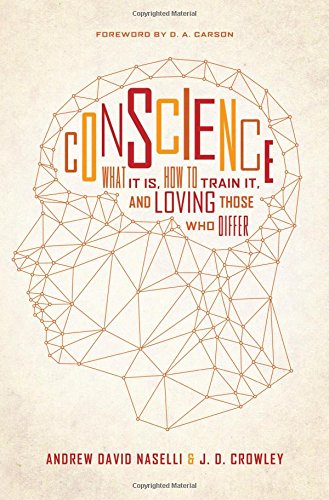
Conscience: What It Is, How to Train It, and Loving Those Who Differ by Andrew David Naselli and JD Crowley is one of the more enjoyable reads I have come across in the past year. It is a relatively short book on a subject that definitely deserves more attention.
I have never read a book specifically on the conscience before, and so it piqued my curiosity. I found that the book reinforced for me just how important the role of conscience is in the life of a believer. The Bible mentions the conscience regularly in Scripture, particularly the New Testament, and speaks of it as being vital to spiritual health. As the authors point out, the Bible says that:
- the aim of biblical teaching is, in part, a good and clean conscience (1 Timothy 1:5)
- a good conscience can save us from shipwrecking our faith (1 Timothy 1:19)
- a good conscience will help us endure persecution (1 Peter 3:16)
- our conscience needs to be guarded because it can grow dull (Titus 1:5)
- our conscience should dictate how we behave in certain circumstances (Romans 14:1-6)
…plus much more. The point is that our conscience—the little voice inside our heads, so to speak—is a precious gift that God has given us and we are to avail ourselves to it. We should inform our conscience, guard it, and obey it.
I found that a lot of the book covered material I already knew but had never really put into fleshed-out, articulate points. I knew, for instance, that Christians ought to give grace to one another on matters that Scripture does not speak clearly of. We should each determine our values and positions and not impose them legalistically on one another. But I had never thought of this in terms of our conscience, and how to make sure our conscience is being guided by faith and not by our sinful inclinations, or how all the little details of each situation should play out. The book was extremely clarifying in this regard. Let me give you an example to help you see what I mean.
As a test case, let’s use the several instances where Christian bakers refused to bake a cake for a gay wedding and were caught in legal trouble as a result. The Bible nowhere gives a direct command for how that believer should respond in this scenario. The Bible does name homosexuality as a sin, and it is therefore fair to say that gay marriage is unbiblical, but how then should a Christian respond when asked to bake the cake? A whole host of critical questions arise:
- Is baking a cake for a gay wedding by nature an act of supporting it?
- Is potentially offending the client the best way to demonstrate Christ’s love to them?
- Is a baker responsible for how their product is used, or only the producing of it?
- Would baking the cake confuse Christians who know the baker as to what their stance is on homosexuality? Might it cause other Christians to stumble?
- If the baker were to reject this client, would they also reject a Christian marrying a non-Christian? And if not, why not?
The list could go on. The point is that the issue is complicated and not something that can be resolved with a simple Bible verse. How should the baker respond? And how should Christians respond to the baker?
The answer is that the baker should study Scripture, pray, seek counsel, and then obey whatever their conscience is telling them to do. And, in turn, Christians who agree or disagree with whatever the baker chooses should be fully convinced in their own mind about how they would have handled the situation, without imposing their conscience onto another. In fact, Romans chapter 14 deals at length with how Christians should handle matters of conscience and treat one another when their consciences differ.
Here’s the rub: if Christians better understood how their consciences worked and how we are supposed to relate to our own consciences and the consciences of others, we would experience much more personal and communal peace. A lot of the hoopla that exists between Christians over matters of conscience would vanish overnight, and that would be a good thing.
Conscience is a small book that contributes to this end. The authors deal with every text of Scripture that mentions the conscience and essentially flesh out a helpful and practical theology of the human conscience. I know it was very helpful and clarifying for me, and I’m sure it will be for you too. I’m giving my recommendation that you add it to your personal library.
You’ve Sinned Again—Now What?
Posted on September 8, 2016 Leave a Comment

What are you to do when you have sinned…again? When you have committed the very sin you resolved to never repeat? When you can’t help but feel defeated, despite the fact you know you’re supposed to be “more than a conqueror”? When you start to wonder if you can ever live a life of holiness? When you find yourself in that familiar place: the guilt-ridden crash that follows the sin you hate and love at the same time? When you are so ashamed of yourself that the absolute last thing you feel like doing is being anywhere near God? When you feel nothing but remorse for what you have done and hopeless that one day this losing battle will be behind you? What should you do when it is painfully obvious to yourself that you don’t deserve God’s love or friendship, and that a wicked sinner like you doesn’t belong within a thousand miles of him?
It’s simple. You should do the very thing you don’t feel like doing. You should march straight into the presence of God. Not when you feel like the guilt has worn off enough that it doesn’t seem quite as awkward, but right away, at the very moment everything is telling you to flee in the other direction. When you don’t want to come near to God is the very time you need to react against your instincts and run to him instead.
How Sin Defeat Us
Sin never works alone. He is a tandem enemy. Not only does sin beat us by providing temptations with which to dupe us, but also doubles that up with a heavy dose of shame and guilt when we fall for the trick. Sin pulls us away from God and then makes us feel like we aren’t worthy of returning. It leads us to walk away from the Lord and then lies by telling us there’s no going back. In that way, sin is doubly-deceptive. It lies about what we should do (break God’s laws), and then what we should do about it afterwards (hide).
This can be seen by the example of Adam and Eve. After falling for the temptation the serpent presented, the couple attempted to hide themselves from God. Their shame became so powerful that they no longer saw God as the one to run to but rather the one to run from. And just as this tactic worked all those years ago, it still works today. All Christians experience the natural feeling of guilt that comes after sin and that unpleasant feeling of wanting to pull back from God. This double-whammy often leaves us alone and stuck in the shame and guilt of sin.
Going On the Offensive
The only way to combat these thoughts and feelings is with truth. We kill the power that lies have over us by slaying them with truth. God’s word is a two-edged sword, and speaks directly to this issue. Here is a passage worth committing to memory:
For we do not have a high priest who is unable to sympathize with our weaknesses, but one who in every respect has been tempted as we are, yet without sin. Let us then with confidence draw near to the throne of grace, that we may receive mercy and find grace to help in time of need. (Hebrews 4:15-16)
The truth in these words are some of the most powerful in all of Scripture. I know they have been very precious to me as I have tried to fight the sin in my own life. Let me break down the phrases and show you why it is such a cherished reality to cling to.
We do not have a high priest unable to sympathize with our weaknesses, but who in every respect has been tempted as we are, yet without sin.
When we sin, or are even tempted by sin, sometimes is it easy to think that God must be disgusted with us. We might imagine Jesus looking on and retorting, “How could you possibly fall for that?” We tend to expect that God would have nothing but disappointment in us.
Now, don’t get me wrong—God is not pleased with our sin. But his response to it is much more than that. This passage says that God sympathizes with us. He looks on our struggle with sin and says, “I know what it’s like. I know what you are fighting with. I’ve been there before.” How can this be? Because Jesus, our great high priest, has experienced the full range of temptation. He became a man and knows what it is like to feel the lure of sin. He has experienced what we do too.
The difference is that Jesus never caved. He resisted temptation every single time. We might want to respond by saying, “If that’s the case, then he really doesn’t know what it’s like!” But think about this for a moment. Who knows the true weight of a bench press: the person who can’t lift the weight on their own, or the person who can do a full press by themself? Jesus took on the full weight of temptation and still resisted. In that sense he actually knows what we experience—and more—when it comes to the power and pull of sin. Jesus really does know what it is like. He can sympathize with you!
Let us then with confidence draw near the throne of grace…
If Jesus can sympathize with our battle against sin, then we should not be ashamed to come to him about it. We will not be met with a dismissive Saviour, but an empathetic one. Knowing that Jesus too has been tempted as we have in our flesh is supposed to arm us with confidence. It is meant to open to door to God, not close it against us. That’s what the verse plainly says!
This is where the battle of the mind becomes so important. The guilt and shame of sin will make you want to run from God. It is a purely natural response. The only way we can overcome the urge to flee is if we are armed with a truth that can overturn those false feelings. Hebrews 4:15-16 is such a weapon. It gives us grounds of assurance that if we come before God with all of our mucky baggage, he will not smite us but rather greet us with a sympathetic embrace. Now that is a powerful promise! It is true whether you feel like it is or not.
…that we may receive mercy and find grace to help in time of need.
It would be nice if Jesus met us with sympathy when we needed it, but he provides so much more than that! The end of this verse says he also offers two other things.
(1) He extends mercy. And thank God for that! Heaven knows we need all the mercy we can get. Our sin is not small. It is not rare. It is not a blip on the radar. It is rather the very thing that draws the wrath of God upon us. But here we are assured that at the throne we can find mercy. Our sin, no matter how egregious or repetitive, can and will be washed away by the mercy that flows from our sympathetic Saviour. Such is the beauty and freedom we have in Christ!
(2) He gives grace to help in time of need. Here the promise is extended beyond only mercy after sin. Jesus is not just helpful once it is too late, but he is there to give grace even before mercy is necessary. We need not wait until sin has taken root in our heart to come before the throne of grace, but rather it is the place we can flee to when temptation is pressing in on us and we are in a great moment of need. Do not be shy about it—with confidence come to Jesus and call for help! He is sure to meet you there with the grace you need to face any trial that comes your way.
Don’t Run From God…Run To Him
I suppose there are few passages in the Bible that have I have leaned on more than Hebrews 4:15-16. Contained in this short section of Scripture is some of the most timely, profound, and precious promises that a believer could ever arm himself with. When sin has you backed into a corner, or has you knocked down on the mat, do the very opposite of what you feel like doing. Don’t hide in shame, but run to the High Priest who will not turn you away, but rather sympathetically give you the mercy and grace you need to get back up again and into the fight. In the sustaining and helping power of Christ we find our Christian victory.
How To Be Happy
Posted on August 3, 2016 Leave a Comment

Everyone wants to be happy, but eventually we all discover that happiness is as elusive as the wind. Experiencing happiness is not so unusual per se, but being able to hang on to it is. That’s why Americans speak of “the pursuit of happiness”. It is something every human chases after, but not many actually find.
Being successful in our pursuit of happiness requires two things: (1) that we know how to get it and (2) that we actually have the ability to get it. To know how to get it but not be able to would be horrifically cruel. To be able to get it but not know how would be just as devastating. We must have both, and the reality is that we can have both.
The Problem Diagnosed
Every human being has two essential, irrevocable longings. We long to be known fully, and we long to be loved completely. These constitute our deepest needs. Without one or both, our soul shrivels up. The reason we struggle to be happy is because trying to find both of these elements together is next to impossible.
We can find someone to love us, but as they get closer and our faults and failures begin to show, we become harder to love. Much of the love we experience is only surface level. The more we are known, the more our ugly side is exposed, the more difficult it is to love us. All of us, whether we would admit it or not, have a side of ourselves we have never exposed to another. We have had thoughts or desires that never made it to the surface of our lives, and even we would be horrified if they did. If you disagree, consider this illustration. What if there were a small TV monitor attached to your forehead that showed every thought that passed through your mind, or if there were a transcriber somehow recording every desire that welled up in your heart, and this information would be made public knowledge, even to your friends and family…would they think any less of you?
Deep down, we all know that if we were to expose every nook and cranny of our souls, there would be a lot there to inspire revolting and disgust. Therefore, we are careful to present ourselves in the best possible manner, because at least then we can find measures of love and acceptance from others.
Or maybe that’s not the case. Maybe you can’t find someone to love you because your ugly side has been exposed. Perhaps some of your worst traits and most repulsive characteristics have been shown for the world to see. In this sense, you really are known by others. But you are not loved by them. They discovered who you really are and recoiled at it. Your true self has become known and met with a lack of love.
In either case, all of us struggle to be both known fully and loved completely. We are either not fully known but loved in a surface level way, or we are fully known but not loved because of the blackness that exists in our hearts.
The way the Bible labels this problem is sin. We are all wicked people, evil at heart, with dark and selfish intentions, and either they bubble to the surface and we are ostracized by society or we keep them fairly under wraps and find degrees of acceptance and love. The world looks on and calls the first a failure and the second a success. But reality is that neither scenario is sufficient to be truly happy.
A Guaranteed Formula For Happiness
Real, lasting happiness comes when we are known fully and loved completely. When our true self is exposed—good, bad, and ugly—and yet we are loved nonetheless, then we find contentment. That is the key to happiness! Unfortunately, that combination doesn’t exist in this world. No one person truly knows us to the depths of our being, and no one person truly loves us despite what they know. It’s impossible. Human beings are not capable of that kind of knowledge or that kind of love.
We would be wise to listen to C.S. Lewis on this point:
If I find in myself desires which nothing in this world can satisfy, the only logical explanation is that I was made for another world.
Human beings cannot meet your deepest needs. They do not have the resources to do so. But God does, and so God can meet your deepest needs. God is the only one who can know you fully and love you completely. He is the only one who can bring those two things together and hold them in perfect harmony. This is not just theoretical. God already proved it to us:
God shows his love for us in that while we were still sinners, Christ died for us. (Romans 5:8)
God sees your sin. He knows you fully, every detestable thing you have ever said, done, or even thought. And he still loves you enough to die for you. God does not love you because he is oblivious to your shortcomings.
Conversely, he does not hate you despite what he sees in your heart. Even though he is aware of every bit of darkness that exists within you, he loves you anyways. He does not run away at the sight of who you really are. Instead, he loves.
This is the good news of the Christian faith. You can be known fully and loved completely. You can have the deepest longings of your heart satisfied in Christ Jesus. You don’t have to continue ignoring who you really are, or feeling like you can never be loved. Instead, you can turn to Jesus and find everything you’ve been looking for. You can be happy, but not without him.
Loving Jesus and Loving the Church Go Hand-In-Hand
Posted on July 26, 2016 Leave a Comment

In some circles it’s pretty cool these days to love Jesus and hate the Church. The last 20 years or so has seen the number of anti-church voices rise significantly, with books and blogs and entire movements surfacing that are almost singularly built on the idea that Jesus is awesome but his followers are not. The labels of Christians being intolerant, judgmental, and hypocritical aren’t just being slung around by those outside the Church, but also by those on the inside. As a result, there are more and more people who are happy to be a follower of Jesus but want absolutely nothing to do with the Christian Church.
I have written about this before, but here all I want to point out is that faith in Jesus and love for his followers are two things that simply go hand-in-hand. You can’t really have one without the other. To do so is to divorce two things that are meant to be inseparable. Certainly, I can understand why many people have issues with the Christian Church. We all do, and there are valid criticisms to be levied against it. But the obvious truth is that Christians are still sinners saved by grace, and we are all in the process of being redeemed and sanctified, so it shouldn’t surprise any of us that local churches are messy and filled with flawed people. After all, those are the only kind of people Jesus came to save.
To love Jesus but hate the church is flat-out wrong. It is more than a personal preference or a personality quirk or a minor theological difference. It is sin. The Church is the bride of Christ. How can someone say they love Jesus and yet slander his bride? How can someone hate the Jesus’ bride when they themselves are supposedly part of that very bride? If a Christian chooses to follow Jesus but wants nothing to do with the Christian church, they are living in a delusion. They have fooled themselves into thinking that Jesus is only interested in his personal relationship with them and not with his gathering for himself a people to glorify him. Read the New Testament; the language of Jesus purchasing a people for himself is everywhere (Acts 20:28, Revelation 5:9, 1 Corinthians 6:20, 1 Peter 2:9, John 10:27).
Actually, you don’t even have to research the entire New Testament. Just read Colossians 1:3-5…
We always thank God, the Father of our Lord Jesus Christ, when we pray for you, since we heard of your faith in Christ Jesus and of the love that you have for all the saints, because of the hope laid up for you in heaven.
What is so plain in Paul’s mind is that faith in Christ and love for the saints go together. They are not separate realities. If you really love Jesus, then you’ll love people who love Jesus. It is literally the most unifying force in the world. Nothing brings people together more than a common love for Christ. If Jesus is my Saviour, my Lord, and my Treasure, and that is true for you too, then we can overlook all kinds of differences to share the same joy in our God.
When Christians try to posit that they are all in on Jesus but not the Church, it shows they either don’t understand what Jesus is all about, or they don’t understand what the Church is, or they simply aren’t born again and don’t understand either one. It is a sign of apostasy at worst and of spiritual immaturity at best. Now, that doesn’t mean we won’t have our issues with other believers. But it is one thing for brothers to sometimes fight, and quite another to simply abandon your family.
Therein lies the rub. The Christian Church is a family. God is our Father, Jesus is our big brother, and we are all brothers and sisters in Christ. Through the cross we have been adopted into God’s family, which means we are in this thing together. You can’t be adopted into a family, want nothing to do with that family, and then reap the benefits that family affords. It doesn’t work that way. Ultimately it is an issue of pride. Either you think you are too good to have the rest of us as brothers and sisters or you think our Dad stinks at picking his kids.
I don’t want to be entirely unsympathetic. I know that some people have been hurt by the Church. For some, the imperfections and sometimes even the grievous sins of the Church have made deep wounds. I’m not going to pretend like it doesn’t happen. But if you are outright blaming the Church for those things, and not the sin that still exists within the Church, you are pointing the finger in the wrong place. The problem is not the Church. The problem is sin, and sin exists even inside the Church and will continue to do so until Jesus finishes his cleansing work and presents himself a bride without spot or blemish on the last day.
My simple message to any Christian who hates the Church is this: a wedding day is coming, and if you are trying with all your might to love the groom but not identify as the bride, you just might find yourself on the outside looking in.
 Canadian Bible Guy