
Jesus the Intolerant
Posted on July 20, 2016 7 Comments

We’re all about tolerance these days. We are demanded by the public at large to be tolerant of those who disagree with us, or fear the collective wrath of society. Of course, most of us know that tolerance never seems to operate as a two way street. When people demand tolerance, what they are really demanding is affirmation. We need to tolerate them, but they don’t need to tolerate us. It’s a false premise that makes absolutely no sense, but for the sake of argument, let’s just roll with it.
Tolerance seems to be the litmus test for whether someone is a good person or not. If you are judged to be a relatively tolerant person, then you are good and wholesome human being. However, if you are judged to be an intolerant person, you are a total bigot. At least it seems to work something like that. We are told from the media and the culture that our job is to tolerate people who differ from us and give support to whatever their various beliefs or behaviours might be.
In most cases, Christians are accused of being intolerant. I know that this charge has been levied against me on more than one occasion. Usually it is because a Christian is stating a moral or religious belief that stems from the Bible. Any time that happens, those who are outside of Christianity accuse us of being intolerant. We hate gays, or we hate women, or we hate Muslims, or whatever the various group happens to be that there is some disagreement with. It is usually pointed out that Christians who are intolerant are being hypocritical. After all, we follow Jesus, a man who was all about radical love! Surely Jesus would never approve of our intolerance towards others. If he were to just show up one day in 2016, almost assuredly he would chastise his followers for their hate and intolerance towards others. Or so the narrative is suggested.
Is Jesus Really Tolerant?
But hold the horses on that one for just a moment. Is it accurate to portray Jesus as someone who, if he were to be transported into today’s world and faced with the cultural firestorm we are, would be nothing but affirming and accepting and tolerant? Would he be cool with all the various beliefs and behaviours that seem to go contrary to the Bible? He is, after all, the guy who let the woman caught in adultery off the hook!
What would Jesus do?
The best predictor of the future is the past. So if we want to know what Jesus might do in our culture today, we should look back into the past and see how Jesus handled controversies back then. Was Jesus ever intolerant of anyone? Or was he always affirming?
You might be surprised to find that Jesus, at least at times, was extremely intolerant.
Not In My House!
I think for example of the story in Matthew 21. In this passage, we see Jesus enter the Temple and go absolutely bonkers on the money changers there. He literally overturned tables, sent money and birds flying, and had everyone running for cover. It was a scene that would have been utterly shocking to everyone present—borderline violent even. He condemns them for their wickedness and accuses them of being thieves basically in the middle of the church foyer. A viral YouTube hit if ever there was one!
I’m not sure about you, but if that footage were to air on the internet today, Jesus would probably get called intolerant.
Jesus was also known to use some pretty harsh language and levy some pretty significant criticisms at times. He is known to have called religious leaders “hypocrites”, “blind guides”, “fools”, “bleached tombs”, and “snakes”, as well as accusing them of being murderers, liars, and full of wickedness. Oh, and all of that came in just one uninterrupted, scathing rant (Matthew 23).
He was known to call out political leaders, teach that God will judge us and send some people to hell, demand that sinners repent, ask his followers to be more devoted to him than to their families, predict that some cities would be brought to ruin by God, say to the Pharisees that their dad is Satan, and tell people to their face that they were wrong and didn’t know what they were talking about.
Make no mistake about it: the Jesus of the Bible is not as tolerant as some have been led to believe.
When Jesus Explicitly Denounced Tolerance
There was also that one time Jesus got really mad because people were being tolerant. See for yourself! In Revelation 2 and 3, Jesus critiques seven churches and gives them some commendations for what they are doing well and some rebukes for what they are doing poorly. Listen to what he has to say to the church in Thyatira:
I know your works, your love and faith and service and patient endurance, and that your latter works exceed the first. But I have this against you, that you tolerate that woman Jezebel, who calls herself a prophetess and is teaching and seducing my servants to practice sexual immorality and to eat food sacrificed to idols. I gave her time to repent, but she refuses to repent of her sexual immorality. Behold, I will throw her onto a sickbed, and those who commit adultery with her I will throw into great tribulation, unless they repent of her works, and I will strike her children dead. And all the churches will know that I am he who searches mind and heart, and I will give to each of you according to your works. But to the rest of you in Thyatira, who do not hold this teaching, who have not learned what some call the deep things of Satan, to you I say, I do not lay on you any other burden. Only hold fast what you have until I come.
It couldn’t be any clearer. Jesus reprimands this church because of their tolerance. Now, granted, he is not condemning every form of tolerance here. That would make no sense. But he is condemning their tolerance for sin, specifically sexual sin and idolatry. These are perhaps the very two areas that today we are supposed to be most tolerant of: sexuality and religion. Evidently in Thyatira, people were practicing all kinds of “alternative lifestyles” and holding to varying religious beliefs. Nowadays, onlookers would simply give their affirmation (ie. tolerance) to these people as being who they are. Yet Jesus looks on and is fuming mad. He warns the church that they should not tolerate such things (specifically among their own people) and threatens significant judgment against them. Later on, in Revelation 19, we see Jesus coming back to earth to set up his own kingdom and basically killing all evildoers on the face of the earth.
What’s the Point?
My point is not to take the caricature of sweet little Jesus who likes to hold baby lambs all day and turn it into fiery UFC Jesus who just berates everyone and has no patience or love for sinners. Rather my point is to push back against the idea that Jesus was a completely tolerant person who was cool with everyone about everything. He most certainly wasn’t and he most certainly still isn’t. He’s God, and he’s a complicated mixture of love and patience and understanding and wrath and judgment and intolerance. Ultimately, his is HOLY, which essentially means he is unlike us. He holds in perfect balance all of these attributes and executes them in perfect harmony. He is not lopsided in any way.
In the end my desire is that we would have the full, biblical picture of Jesus. One that sees him as the Creator God of the universe who will judge sinners and condemn them accordingly, but also who is the loving Saviour who came to earth to die on behalf of evildoers like you and I. He will not tolerate sin or anything that robs him of glory. But he is also patient with us and gives us a way out. He opens the door to complete acceptance with him—something which is far better than mere tolerance of us—and does so at the cost of his own life. What kind of God is this, a righteous Judge who offers himself for the guilty? A great one, in my estimation. One worthy of my worship and trust. But also one who exercises tolerance only for a time. I have chosen to repent and believe in the forgiveness he offers before it is too late. I hope that you will too.
Understanding Teens and Their Emotional Bank Accounts
Posted on July 19, 2016 Leave a Comment
Disclaimer – I write “Leadership Moments” for the volunteers at my church who work in the youth ministry. Each Leadership Moment is meant to equip the everyday youth worker with the knowledge and skills they need to disciple teens as best as they can. Because these articles are for people I know personally and meant for my own church and city context, they may not always be relevant to the wider public. However I put them here for anyone who might benefit from their content.

Image source: gottman.com
Stephen Covey made popular the idea that everyone has an emotional bank account. People feel happy and fulfilled when they have a full account, and they feel depleted and discouraged when their account is overdrawn. The currency that is used is trust. When actions are done to prove a person trustworthy, they build equity with us. When actions are done that prove a person untrustworthy, they lose equity. It’s a simple metaphor that makes a lot of sense.
As youth workers, we can put this analogy to good use. Our job is to disciple students and help them along in their walk with Christ. This requires relationships. But any good relationship of influence is built over time. So if we take seriously our call to impact the lives of teens, then we must also take seriously the need for us to build their trust.
We need students to trust us so that we have an open window to speak into their lives. Teens are skeptical, and often rightly so. They can sniff out fake intentions from a mile away. As youth leaders, we can’t really speak into the life of a young person until we have earned the right to do so. Doing that requires us to make deposits into their emotional bank account.
To give you a more practical idea of how this works, consider some examples of what a deposit might look like:
- attending their sporting event, music/dance recital, or other significant event
- taking them out to spend time and talk
- writing a personal note of encouragement
- remembering significant things going on in their lives
- praying with and for them
- going out of your way to help them in an emergency
- making yourself available to them
- helping them find resources they need for a school project or crisis situation
- listening more than you talk
- being patient and showing understanding
- buying them a gift
- helping them to cope with a situation you know they are uncomfortable with
- apologizing when we make a mistake
You get the idea. Students want to know we care before they care to hear what we have to say. These are all examples of ways we can make deposits into a teens emotional bank account. We should be intentional about this. Then, when it comes time for us to make a withdrawal, our voice is more likely to be heard.
Some examples of withdrawal are:
- calling a student out on something they did wrong
- creating a higher level of expectation for them
- requiring them to be accountable to you in some way
- challenging their thinking on a specific subject
- refusing to tolerate behaviour that is unacceptable
- exercising forms of “tough love”
- accidentally letting them down
Withdrawals are only successful if there are enough funds already there to use. Consider this illustration.
Susan is a teen who is in her third year of youth group. She professes to follow Christ but lately her behaviour has been going south. She’s dating a non-Christian guy, skipping school, and has taken up smoking. Lisa is a youth leader who just started volunteering 2 months ago. She takes it upon herself on a Wednesday night to confront Susan in the hallway after youth group and point out her sinful actions and challenge her to truly follow Christ. As a result, Susan storms out and stops coming to youth group altogether.
It is not hard to see what is wrong with this scenario. Lisa’s intentions as a youth leader were probably good—she wanted to see Susan stop going down a path that would take her away from Christ and towards a life of destruction. But her actions were too intense and too soon. She had not yet built up the relational capital with Susan to speak into her life. She had not developed a level of trust first. As a result, Lisa took it as an attack from a stranger who she wasn’t convinced actually cared about her and walked away.
Now, let’s try this scenario over again, applying better wisdom.
In her 2 months, Lisa has noticed some of the negative things going on in Susan’s life. She wants to help her but also realizes the two barely even know each other. Lisa decides to ask Susan if she’d like to meet up for coffee on the weekend to get to know one another. She also talks to Brittany, another youth leader who has been there for a while and has a past history with Susan. Lisa asks Brittany about the situation and tries to get some background info on Susan, and also decide that they will keep in contact with each other about how she is doing.
See the difference?
In scenario one, Lisa’s heart was in the right place but she had not built up the level of trust it takes to have a confrontation like the one she had. She attempted to make a withdrawal before she had bothered to make any deposits, and ultimately found things went bankrupt. In scenario two, Lisa tries to begin to make some deposits that she can leverage later down the road, and also leans on Susan’s current relationship with Brittany the primary source of impact.
The point is this: if we want to have the kind of impact on students that make a difference in their lives, it means we are going to have to personally invest in them first.
Homework Assignment
- What is a recent example (past 6 months) of you making a deposit into a student’s life? What is a recent example of you making a withdrawal?
- Name one student you intend to make relational deposit into this summer. How you do intend to do that?
There’s Hope for This Hopeless World
Posted on July 7, 2016 Leave a Comment

Brendan Gleeson as August Nicholson, “The Village”, 2004.
“You may run from sorrow as we have. Sorrow will find you.” – August Nicholson, The Village
It is not hard to feel that the world in which we live is entirely hopeless. Who could blame someone for coming to such a conclusion? Life does not just include sorrow; it seems to be filled with it. Sorrow is inescapable. It is like a lion pursuing it’s prey, closing the gap and going for the kill. Everyone on planet earth knows that life as we know it is broken. Or perhaps it’s more like a Frankenstein monster—it looks something like what we might expect but with horrific deformities and a patchwork solution attempting to cover up the obvious, fatal flaws.
I find it almost unbearable at times. Look around the world and what do you see? You see millions of women and children being exploited for money in the sex trade. You see millions of people starving to death and dying from preventable diseases. You see families being torn apart by absentee fathers, or marriages that break apart too quickly and leave devastating effects. You see boys as young as 12 getting hooked on violent internet pornography. You see movies and music and video games supporting a rape culture and the degradation of women and minorities. You see political power plays, injustice at every turn, racism, sexism, and just downright hatred for our fellow man. You see natural disasters that tear apart whole communities and tsunamis that kill in the hundreds of thousands. You see unborn babies murdered in the womb, and many who were wanted but still never made it to full term. You see roughly 1 in 5 girls and 1 in 20 boys who are sexually molested. You see corrupt religion exploiting vulnerable people for money. You see the innocent being trampled on and the guilty getting off the hook. You see suicide bombers and mass shootings so often it doesn’t even shock anymore. The list could go on, but in short what we see is that our world is beyond messed up and it doesn’t seem like it’s getting any better.
While we all know something is terribly awry, we also intrinsically have hope for a better tomorrow. We fight off despair by finding something to give us a glimpse of the things that could be. We trust in politicians, or in religious leaders, or in celebrities, or in health care, or prescription medications, or in causes we can get behind. On a personal level, we hope in our spouse, our boyfriend or girlfriend, our children, a promising job, a clever investment, an attractive appearance, or whatever else we delude ourselves into thinking might deliver us and bring meaning to our otherwise depressing condition.
Let me just say three simple things.
First, we are right to gravitate towards despair. The world really is a cruel place. Of course, we can always find the silver lining, but for the most part we are being sucked down by the pull of a quicksand we simply can’t escape.
Second, we are right to fight for hope. Human beings were made for hope. Indeed, we were made to hope! We are not meant to just give in and accept the reality around us. We’re not supposed to just make peace with the plight. We are right to look beyond.
Third, we are insane to look for hope anywhere on this planet. Mankind has existed for millennia, and supposedly we are on an evolutionary trajectory that is trending upward. We are supposed to be learning from our mistakes and moving forward, aren’t we? Yet here we are—dare I say it—no better off than we have been at any point in the past. The saying hope in humanity restored has got to be the most temporary, superficial relief imaginable, comparable to an ostrich sticking its head in the sand in the presence of immanent danger.
I’ve got news for you. Human beings have had their chance, and we’ve gotten nowhere. Life is still a conveyor belt of corpses and that’s never going to change because of anything we do. What we need is not faith in humanity. What we need is intervention. What we need is help from the outside. What we need is something…no, someone…who is more powerful than we, more noble than we, more trustworthy than we, more gracious than we, more loving than we, to swoop in from out of nowhere and save the day. What we need is a hero. What we need is not to trust ourselves but to wholly distrust ourselves and find one who can take this impossible burden and make it right. Does such a miracle-worker exist?
The greatest hope in the entire universe is that such a hero does exist! You know where I’m going with this; but then again, maybe not. I’m not talking about some vague notion of God, some blind hope that a being out there exists who just might, if he felt so inclined, show us a hint of sympathy. I’m not talking about man-made religion or general, indefinable notions of the Supreme. Screw man-made religion! Screw baseless, positive thinking or belief in a nameless force! What I’m talking about here is far more definable than that, far more reliable and far more real.
You can call me crazy if you want, but Jesus of Nazareth, the God-man, is the only hope for our world. He and he alone is the one who can deliver us from the plight we are in. The real Jesus of history past, God’s only Son who came to take upon himself the sins of the world, and the one who promises to come again in power to conquer the kingdoms of the world and set up his own, this Jesus is the one in which we need to place our hope.
Naysayers and skeptics retort. Jesus? He’s a product of revisionist history. His miraculous fables come from a culture that had no scientific stabilizing forces. He’s just an exaggerated, magic-working carpenter at best or a complete myth at worst. You expect me to believe in your God who couldn’t even stop himself from being nailed to a piece of wood? The universe’s hero, hanging on a bloody cross? Utter foolishness.
No, my friend. What is utter foolishness is thinking that human beings can turn around the mess we find ourselves in. What is utter foolishness is passing over the only Person who has ever stared death in the face and came out the victor. What is utter foolishness is living your life hoping by some chance that it will all go well for you, that you can dodge the bullets of misery that life fires your way, that somehow the people and things of this world can give you enough to overcome the snowball of despair that is growing all around you. You can’t escape it. We can’t escape it. At least, that is, not on our own.
I believe with all my heart that the world is beyond healing—beyond human healing that is. We’re in over our heads. Can you possibly not agree? Here we are in 2016. You would think we would have figured some things out by now. But it’s quite the opposite. Things are worse than ever, and 24 hour news is a continual reminder of this.
Jesus is the hope of the world. He is the hope for us all as a collective humanity, and he is the hope for each of us personally. He’s not an option. He is the option. The central truth of my life is that “there is no other name under heaven by which we must be saved”. There is one name, and his name is Jesus Christ. If you want to know everything I stand for, everything I believe in, everything I hope in, that sums it up right there.
Lift your drooping head, and strengthen your weakened hands! We do not wait for hope as one waits for the lottery to call your number. No, we wait for hope as those who stand on rock-solid assurance that Jesus will fulfill his promises. How can we know? The empty tomb. The strongest force on earth was not strong enough to keep down Jesus Christ. Want to know why? Because Jesus is not of this world. He owns it; indeed he created it. And he promises to restore it to its former glory. When the time comes Jesus will reverse the curse and bring healing, restoration, and fullness of life. He will do that for all who put their hope in him, and we will enjoy life in the renewed creation where all of the junk of this world will be forever in the past. That day is coming. I, for one, can’t wait for it. Come, Lord Jesus!
For those who think I’m spewing a bunch of religious nonsense, I only have one question that I ask you to seriously ponder. Why would you not want me to be right?
The 12 Works of Jesus
Posted on June 30, 2016 Leave a Comment

When people talk about the core of Christianity, the phrase that is sometimes used to describe it is “the person and work of Jesus”. The person of Jesus refers to who he is (son of God, Messiah, Redeemer), while the work of Jesus refers to what he has done. Though more could be added, here are 12 works of Jesus.
1. Jesus creates us
Everything and everyone on the planet and in the universe was made by Jesus. John 1:3 states about Jesus, “All things were made through him, and without him was not any thing made that was made.” If it exists, it’s because of the creating work of Jesus. Beyond even this, not only has Jesus made all things, but he has made them for himself. Colossians 1:16 says “all things were created through him and for him”. Quite simply, this means that Jesus himself has brought you into existence and he did it for his own purposes. You matter and your life has infinite meaning!
2. Jesus continues with us
The story of the Bible is that after God created everything and declared it to be “very good”, mankind rebelled against God. We sinned against him, attempting to usurp his throne and take it for ourselves. Ever since, death and disease and decay have been a part of life on this fallen earth. We all sin against God (Romans 3:23), yet he does not destroy us. Instead, God loves his enemies by continuing with us, showing patience, giving grace, and ultimately setting in motion a plan—at his own expense, no less—for our restoration.
3. Jesus came for us
The plan of restoring mankind came to a climax when Jesus came to earth. Jesus said in no uncertain terms that he “came to seek and save the lost” (Luke 19:10). Rather than leaving us in our helpless, wretched condition, God intervened. He got involved, and did so by putting himself in our place. Jesus died on the cross to take the full penalty of our own sin, in order to liberate us from the curse. 1 Peter 3:18 summarizes: “Christ also suffered once for sins, the righteous for the unrighteous, that he might bring us to God.”
4. Jesus convicts us
Rather than condemn us for sin, Jesus convicts us of sin. What’s the difference? Condemnation leads to shame and punishment, but conviction leads to a plea for help. In his kindness, Jesus shows us that we are sinners, that we have fallen short, that we are broken beyond our ability to repair. He does this not to crush us, but to liberate us. Humanity, left to our own devices, is doomed. Only once we see the hopeless condition we are in will we turn to Christ for help…and he is happy and able to give it!
5. Jesus calls us
Jesus doesn’t just open up the possibility of salvation; he also calls us to it! “My sheep hear my voice, and I know them, and they follow me. I give them eternal life, and they will never perish, and no one will snatch them out of my hand” (John 10:27-28). He is actively reaching out and calling each of us to respond to him in faith. His invitation is not limited but extends out into the whole world (John 12:32).
6. Jesus converts us
To become a Christian (a follower of Jesus) is an act of repentance and faith: turning from sin and believing in Jesus as Saviour and Lord. While this is something we are each called to, it really is a supernatural act of God. Becoming a Christian is more than a mere decision; it is the creation of a whole new person. “Therefore, if anyone is in Christ, he is a new creation. The old has passed away; behold, the new has come” (2 Corinthians 5:17). When a sinner converts it is because the saving work of Jesus has been applied to their heart.
7. Jesus cleanses us
All who trust in Christ as their Saviour are cleansed from past, present, and future sin. Our guilt is washed away and we are made sinless and spotless in the eyes of God. 1 John 1:9 states, “If we confess our sins, he is faithful and just to forgive us our sins and to cleanse us from all unrighteousness.” In the Bible, sin is often likened to an ugly stain. Though our sin is as obvious and unbecoming as red wine spilled on a white carpet, God has the miracle-working power to remove the stain completely. Isaiah 1:18 says “though your sins are like scarlet, they shall be as white as snow; though they are red like crimson, they shall become like wool.”
8. Jesus changes us
Jesus doesn’t just remove our sin and then leave us to try and do better next time; rather, he also empowers us to change and become more like him. God’s grace is not just about second chances. It is also about the transformation of every believer. The more we grow in our relationship with Christ, with eyes fixed on him, the more our lives will become conformed to his likeness. 2 Corinthians 3:18 states “And we all, with unveiled face, beholding the glory of the Lord, are being transformed into the same image from one degree of glory to another.”
9. Jesus commissions us
The Christian life is not about getting converted and then simply resuming business as usual until we die. Instead, our faith also bring with it a special commission from Jesus, a task that he demands his followers apply themselves to. Jesus gives his great commission in Matthew 28:18-20, “All authority in heaven and on earth has been given to me. Go therefore and make disciples of all nations, baptizing them in the name of the Father and of the Son and of the Holy Spirit, teaching them to observe all that I have commanded you. And behold, I am with you always, to the end of the age.” Quite simply, Christians are called to grow the kingdom of heaven and spread the gospel of Jesus everywhere they go, even to the far reaches of the earth.
10. Jesus carries us
Have you ever felt weary, fellow Christian? Have you ever stumbled, dealt with doubt, or wondered how God could ever put up with a lousy Christian like you? Fear not! Jesus does not start a job and then leave it unfinished. Rather, he promises to see the project (you!) through to completion. His own power will carry you and make sure your faith does not fail. Wether or not your faith continues does not ultimately rely on you, but on the one who bought you. Lean on the promise of Philippians 1:6, “And I am sure of this, that he who began a good work in you will bring it to completion at the day of Jesus Christ.”
11. Jesus celebrates us
When we think of heaven, one of the first things that come to mind is Christians worshipping God. That is fitting and true. But there is more to it! The Bible teaches that Jesus himself will not only receive praise from his people, but will also rejoice over his people. He will celebrate and honour all who enter into his kingdom. Zephaniah 3:17 gives us a glimpse: “The LORD your God is in your midst, a mighty one who will save; he will rejoice over you with gladness; he will quiet you by his love; he will exult over you with loud singing.”
12. Jesus completes us
At long last, when The Day of the Lord finally comes, the world as we know it will end: no more sickness, sin, death, disease, pain, betrayal, loneliness, or anything else of that nature. We will be made complete and brought wholly into the redemption that Jesus bought for us on the cross. Our souls will be cleansed, our bodies resurrected to new life, and we will be in the presence of the risen Christ forever, experiencing the fullness of life as God always intended it to be lived. The promise of John 10:10 will finally be realized: “I came that they may have life and have it abundantly.”
Friend, if Jesus creates us, continues with us, came for us, convicts us, calls us, converts us, cleanses us, changes us, commissions us, carries us, celebrates us, and completes us, why would you do anything but cast yourself on him?
When Slamming Pharisees Makes You a Pharisee
Posted on June 13, 2016 Leave a Comment
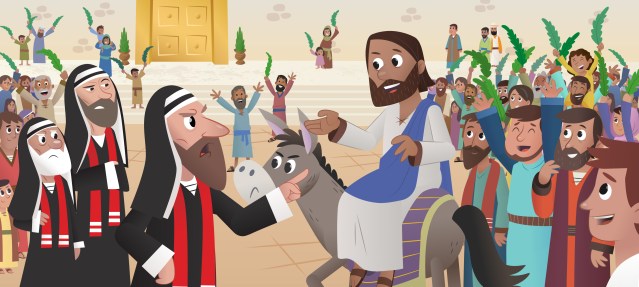
Image from YouVersion Bible app for kids
We love to hammer on the Pharisees. A group of people who were often revered (or simply feared) by others in their day have become punching bags for those of us on team Jesus. Our Saviour held nothing back when confronting the Pharisees on their hypocrisy and self-righteousness, and we not only cheer him on but like to join in the party.
Pharisees deserve the criticism they get from the Lord. Jesus doesn’t misjudge or mistreat anyone, and his attack on their pride of self and disdain for others is perfectly justified. Pharisees think they are righteous because they compare themselves to other people. They think they stack up pretty well against the common sinner, and so they believe that God is rather impressed with them. Jesus showed us that is not the case. God is frustrated with their refusal to humble themselves and recognize that he sees not only the actions of the body but also the motives of the heart. God is not pleased with a cleaned up life when our hearts are full of ugly things.
And so those of us who reject man-made religion and self-righteousness (which we ought) are quick to come alongside Jesus and slam the Pharisees. We call people out on their hypocrisy and pride. We reject the traditions of men that override the Word of God. We are full of disdain for those who would think too highly of themselves. And so we run in the exact opposite direction. We throw off unbiblical rules and refuse to act superior to common sinners. We intentionally do the opposite of what Pharisees do. We become, as it were, anti-Pharisees.
Not So Fast!
Here’s the problem. Unlike Jesus, it is common that in our opposition of Pharisees we actually become one. Think about it. Pharisees define themselves by comparing themselves to other people. So do anti-Pharisees. While the Pharisee compares himself favourably to sinners, anti-Pharisee compares himself favourably to Pharisees. A Pharisee looks down on someone unlike him, and so does the anti-Pharisee. In his stance against pride, the anti-Pharisee actually assumes a position of pride. He looks at those trapped in self-righteous religion, those who judge others and think themselves to be better, and recoils in disgust. He thinks to himself, How can they not see their pride? Don’t they know they are a sinner too? It makes me sick. Those stinkin’ Pharisees are just the worst. Thank God I’m not like that!
These remarks sound awfully familiar.
“Two men went up into the temple to pray, one a Pharisee and the other a tax collector. The Pharisee, standing by himself, prayed thus: ‘God, I thank you that I am not like other men, extortioners, unjust, adulterers, or even like this tax collector. I fast twice a week; I give tithes of all that I get.’ But the tax collector, standing far off, would not even lift up his eyes to heaven, but beat his breast, saying, ‘God, be merciful to me, a sinner!’ (Luke 18:10-13)
The anti-Pharisee is actually a Pharisee at heart. Even though they seem to take a hard stance against religion and self-righteousness, they end up becoming religious and self-righteous. If we are not careful, we will look at the person who says “Thank God I’m not like other people” and then think to ourselves “Thank God I’m not like them”.
What Is the Remedy?
If we can become a Pharisee by opposing them, should be stop doing it? The answer is no, but we need to do it in the right way. Jesus had no problem opposing the mindset of a Pharisee. He had some harsh words about it. But there is one sense in which we cannot exactly follow Jesus’ steps in this matter. Unlike us, Jesus was sinless, and therefore he did not fall into the trap of pride like we can.
So how can we still be against the Pharisee mindset while not becoming one? By comparing ourselves to God and not to others. The Pharisee in Luke 18 commends himself by comparing himself to others (sinners). The anti-Pharisee likewise commends himself by comparing himself to others (Pharisees). However, the true believer commends himself by comparing himself to God, realizing his failures, and crying out for mercy. In this way he is not commending himself at all, but rather admitting he is not commendable. In the parable of Luke 18, only the individual who compares himself not to others but to God and cries out for mercy actually receives it.
It can be tempting to want to slam Pharisees, no holds barred. That appears to be what Jesus did, and so we feel good in jumping in. But we must approach it in a different manner. Yes, it is right to oppose self-righteousness, but not by becoming a different kind of self-righteous yourself. Rather, we oppose self-righteousness by advocating for God-righteousness. We don’t pridefully compare ourselves to others, but become humble in confessing that we ourselves don’t measure up. We don’t get enjoyment out of slamming Pharisees, because in doing so we become one. Rather we oppose Pharisees while having great love for them and realizing we are a lot more like them than we may first imagine.
The Craziest Thing Happened to Me Today
Posted on May 25, 2016 Leave a Comment

So the craziest thing happened to me today!
I went into the bathroom at my house this morning, and when I turned this little metal knob, water came spouting straight out of the wall! It was conveniently landing in a container that I could stand in so the water didn’t splash around everywhere. And not only this, if I turned the little knob this way or that, I could adjust the temperature of the water to suit my specific preference! And to top it all off, the water was totally clean, free from silt or mud or anything. It really was the most remarkable thing.
What’s that? This doesn’t sound crazy to you?
Of course it doesn’t. You know exactly what I’m talking about. I had a shower this morning. Whoopdie doo! There’s a good chance you did too. People shower all the time, right? It’s not exactly a big deal. It’s common routine for people like you and I. We practically do it without even thinking about it.
And that’s just the point.
It is estimated that about 40% of the world’s population doesn’t have indoor plumbing. That equals almost 3 billion people who must bathe in a river or in a basin they filled with buckets…or who simply never bathe at all.
And if you push it even farther, indoor plumbing is a modern invention, which means that virtually countless billions of people over the course of human history have no idea what it’s like to wake up in the morning and have a hot shower, much less to know what it’s like for that to be normal and mundane.
Here’s the point: we have so much more to be thankful for than we realize. We enjoy thousands of blessings every day and hardly even notice them. What’s worse is that we don’t just fail to notice them…we actually complain about them all the time. We are horrifically ungrateful people, if we even bother to pay attention to our lives at all. It’s a shame, really, and I’m just as guilty as everyone else.
Today, why not take a moment to be thankful for the small things: the shower, the food in the fridge, the roof over your head, the music in your ears, the smell of the flowers outside, the striking blue of the sky, the deliciousness of your favourite snack, the fact that you can inhale air and your body somehow turns that into sustainable resources. Seriously, what the heck is our existence, anyways? Pretty amazing when you think about it.
Give thanks today to the one who Created you, and remember just how fortunate you really are!
Give thanks in all circumstances; for this is the will of God in Christ Jesus for you. (1 Thessalonians 5:18)
Let everything that has breath praise the Lord! Praise the Lord! (Psalm 150:6)
Every good and perfect gift is from above, coming down from the Father of the heavenly lights (James 1:17)
Keep This In Mind When You Say “Only God Can Judge Me”
Posted on May 24, 2016 1 Comment

You’ve heard it said before: You can’t judge me…Only God can judge me!
Usually this line is spouted off when someone feels they are being unfairly criticized by another. It is used as a defense mechanism, a clever comeback that sounds quite spiritual but in reality is simply being wielded as a weapon against others who have come too far into our personal space. When we feel like our life choices are being put under the microscope by someone else, we feel threatened, and want to find a way out from under the scrutiny. Pointing out that “only God can judge me” works because it feels like a God-supported truth that no one can really refute, and it conveniently (1) alleviates us of any guilt we might have felt and (2) puts the smug critic in their place.
Here’s the problem. Even if that were a true statement (and biblically it’s not exactly true), the reality is this: you should be a whole lot more scared that God will judge you than if someone else does!
Therein lies the irony. The “only God can judge me” line is used to make us feel safe from judgment, yet it actually confirms that we are anything but safe from judgment. True, human beings are imperfect and therefore we know their judgment of us will be skewed, so we can take some reassurance in knowing that God’s judgment of us will be flawless. Yet, at the same time, if that is true, shouldn’t we be worried that God knows every dirty little secret we have and will judge us in accordance with everything we have done, said, and even thought?
The Bible speaks of God’s judgment not as a convenient way to push back critics, but as a warning siren to sinners like you and I:
- Hebrews 9:27 And just as it is appointed for man to die once, and after that comes judgment
- Romans 14:12 So then each of us will give an account of himself to God.
- 2 Corinthians 5:10 For we must all appear before the judgment seat of Christ, so that each one may receive what is due for what he has done in the body, whether good or evil.
- Matthew 12:36 I tell you, on the day of judgment people will give account for every careless word they speak
- Romans 2:5-6 But because of your hard and impenitent heart you are storing up wrath for yourself on the day of wrath when God’s righteous judgment will be revealed. He will render to each one according to his works
The point is this: God is indeed the one who will judge you, and that should terrify you. It should be anything but a statement used to make us feel better about ourselves. Rather, it should make us keenly aware of our sinfulness before God and how unworthy we are to be accepted by him. It should make us shudder at the thought of sinful beings like us standing before a sinless God on a day of judgment, where God will render to each person according to what they have done.
Perhaps you think you are a good person and that judgment will go well for you. I would advise no one to take that stance. Far better it is to recognize your sin and seek out the forgiveness that God offers us through Jesus Christ. God is willing to grant total forgiveness to all who admit their need for God’s mercy and believe in the deliverance that comes only through Christ. This means that if you trust in Jesus as your Saviour (the one who saves you from judgment), then God will not count any of your sins against you. But don’t take my word for it. The Bible says so:
To [Jesus] all the prophets bear witness that everyone who believes in him receives forgiveness of sins through his name. (Acts 10:43)
And because of Jesus dying on the cross for your sins and mine, God is willing to grant us mercy, if only we would have the faith to receive it. James 2:13 reminds us that “mercy triumphs over judgment”…but only if we ask!
So, if you want to really escape the feeling of being judged, then believe in Jesus for the forgiveness of your sins. You can know, on the authority of God’s Word, that God will not count any sin against you that Jesus has already forgiven you for. Now that is the freedom you are looking for!
10 Weapons in the Devil’s Arsenal
Posted on May 12, 2016 5 Comments

The Christian life is a fight, and it is one not against people but against the forces of darkness in our world. Our enemy is vicious but also sneaky, in that he doesn’t always attack us in ways that are obvious. When some people think of the devil showing up, they picture spinning heads and moving furniture and ghostly figures on the wall. While that can happen, most of the time the devil tends to be more discreet than that. His tactics are clever and cunning, and unless we are aware of what they are, we will be susceptible when he shows up to strike a blow.
Here are 10 weapons in the devil’s arsenal:
1. Lies
John 8:44 You are of your father the devil, and your will is to do your father’s desires. He was a murderer from the beginning, and does not stand in the truth, because there is no truth in him. When he lies, he speaks out of his own character, for he is a liar and the father of lies.
The devil was, is, and always will be, a liar. He hates the truth and it is in his very nature to contradict it. He uses falsehood of all kinds – from blatant lies to clever deceptions – to disrupt God’s plan for our lives, and the only way we can fight back is to know the truth, and have the truth set us free (John 8:32).
2. Temptation
Matthew 4:1-3 Then Jesus was led up by the Spirit into the wilderness to be tempted by the devil. [2] And after fasting forty days and forty nights, he was hungry. [3] And the tempter came and said to him, “If you are the Son of God, command these stones to become loaves of bread.”
The devil can’t make anyone do anything, but he loves to put temptation in our path in order to get us to lure ourselves into sin. He tries to pull us away from God by introducing into our lives things that compete for our devotion and affection. Like a donkey chasing a carrot around, he simply dangles something enticing before us and lets us do the rest. In order for us to resist temptation, we must see it for what it is: something that is giving us a promise it can’t deliver on, and rely instead on the sure promises of God’s Word (1 Corinthians 10:13).
3. Twisting Scripture
Matthew 4:5-7 [5] Then the devil took him to the holy city and set him on the pinnacle of the temple [6] and said to him, “If you are the Son of God, throw yourself down, for it is written, “‘He will command his angels concerning you,’ and “‘On their hands they will bear you up, lest you strike your foot against a stone.’” [7] Jesus said to him, “Again it is written, ‘You shall not put the Lord your God to the test.’”
Isn’t it remarkable that in his temptation of Jesus, the devil quotes the Bible? The reality is that Satan knows the Scriptures inside and out – he simply hates what he knows and misuses it to take advantage of ignorant people. Many people believe they have a saving relationship with Jesus when they do not, simply because they have been deluded by false teaching. One of the devil’s most clever tactics is to promote his lies inside the Church, and he uses bad Bible teaching to achieve this purpose. We can only keep ourselves from being led astray in this manner by knowing the Bible for ourselves (1 John 4:1).
4. Doubt
Genesis 3:1 Now the serpent was more crafty than any other beast of the field that the LORD God had made. He said to the woman, “Did God actually say, ‘You shall not eat of any tree in the garden’?”
Satan can’t force you to believe anything, but he can ask questions that cast doubt on your beliefs. This was his tactic in the garden when he deceived Eve, and it all begin with a simple question: did God really say…? The subtlety and slyness of the question caused her to overthink it, and suddenly she began to doubt God’s trustworthiness. In order for believers to overcome their doubts, we need to be honest about them, take them to God in prayer, and feed our faith with the truth of God’s Word (Romans 10:17).
5. Accusation
Revelation 12:10 And I heard a loud voice in heaven, saying, “Now the salvation and the power and the kingdom of our God and the authority of his Christ have come, for the accuser of our brothers has been thrown down, who accuses them day and night before our God.”
If Satan loves to accuse people, we sure give him plenty to work with! Every sin we commit gives the devil another thing he can try to accuse us of: What a terrible thing you did! God can’t possibly forgive you for that. There’s no hope for you. You say you’re a Christian but really you’re a phoney. He can sling accusations our way, but the only way for us to not be rattled by them is to appeal to the Supreme Court of heaven and let Jesus, our defense attorney, fight for us. And because our standing before God rests on our forgiveness through confession and the blood of Christ, we are cleared of every charge the devil can bring (1 John 1:9).
6. Pain
1 Peter 5:8-10 [8] Be sober-minded; be watchful. Your adversary the devil prowls around like a roaring lion, seeking someone to devour. [9] Resist him, firm in your faith, knowing that the same kinds of suffering are being experienced by your brotherhood throughout the world. [10] And after you have suffered a little while, the God of all grace, who has called you to his eternal glory in Christ, will himself restore, confirm, strengthen, and establish you.
This prowling lion has an appetite for one thing: faith. He is hungry to take from people their faith in Christ and one of his main ways of trying to do that is through suffering. In the midst of pain, we often get angry at God, doubt his love for us, and even walk away from him for a season of time (or worse, permanently). But the struggles of this life don’t have to shipwreck our faith. The Bible warns us that hard times are coming, that God will use them for good, and that we will be richly rewarded for all that we suffer when we reach the homeland of heaven (2 Corinthians 4:16-18).
7. Pleasure
Deuteronomy 28:47-48 Because you did not serve the LORD your God with joyfulness and gladness of heart, because of the abundance of all things, [48] therefore you shall serve your enemies…
Proverbs 30:8-9 …give me neither poverty nor riches; feed me with the food that is needful for me, [9] lest I be full and deny you and say, “Who is the LORD?” or lest I be poor and steal and profane the name of my God.
Just as Satan can use pain to attack us, he can conversely use pleasure to lull us to sleep. It could be true that more people are kept from faith in Jesus in North America because of pleasure than because of pain. When we live in abundance, good health, and general ease and comfort, who feels the need to cry out to God? Who feels compelled to acknowledge him and honour him above all? Rather than withhold good things, sometimes the devil will fill our lives with them in an effort to get us to forget how desperate we really are and how badly we need God’s grace. We can only stay alert and desirous for God in the midst of abundance when we understand how badly we really need him (Luke 12:13-21).
8. Unforgiveness
2 Corinthians 2:10-11 Anyone whom you forgive, I also forgive. Indeed, what I have forgiven, if I have forgiven anything, has been for your sake in the presence of Christ, [11] so that we would not be outwitted by Satan; for we are not ignorant of his designs.
If God takes great delight in forgiving others, then the devil takes great delight in fostering bitterness towards others. Satan has great contempt for forgiveness probably because God has not and will not offer it to him. And our enemy goes to great lengths to see that we not only fail to ask God for forgiveness, but also that we harbour unforgiveness towards those who have wronged us. Nothing can kill a tender heart towards God quite like a spirit of unforgiveness. The way we can ensure that never happens to us is to see the ways that others have wronged us as puny in comparison to the way we have wronged God. And if he is willing to forgive us a debt of 10 billion dollars, then we can forgive someone else of a 10 dollar debt (Matthew 18:21-35).
9. Isolation
Matthew 4:1 Then Jesus was led up by the Spirit into the wilderness to be tempted by the devil.
The devil loves to strike us in our moments of weakness, and we are perhaps never weaker than when we are alone. A person who is in isolation cannot draw on the help of another, and they are a sitting duck for someone as crafty as Satan. He pounces in our moments of vulnerability because he gets the most traction out of it, but we can combat this by being people who are in fulfilling, healthy, and uplifting relationships with other believers, especially in the context of a local church (Hebrews 10:25).
10. Fear
Psalm 23:4 Even though I walk through the valley of the shadow of death, I will fear no evil, for you are with me;
Fear is one of the most controlling emotions a person can experience. The devil uses this to his advantage by encouraging fear in our lives. We fear all sorts of things: circumstances, other people, the future, things we can’t control, and so on. Yet God does not want us to live our lives in fear, but rather in the confidence that he is with us and the love that comes from our relationship with him (1 John 4:18).
Know your enemy, thwart his tactics, and make him powerless in your life!
A Plea For Theologically Rich Youth Ministries
Posted on May 2, 2016 Leave a Comment

Youth ministry has come a long way over the past 20 or 30 years. Fading fast are the models of ministry that were heavy on entertainment and light on truth. I am glad for this! There’s nothing wrong with having fun in youth ministry; in fact, I think it should have elements of fun. But we know that youth ministries need to be built on much more than that.
I try to think like this: what have I given my students to hold on to for the day they hit rock bottom? Make no mistake about it. That day is coming. For some it has happened already. Life inevitably takes a turn for the worse and we are left barreling in a downward spiral until we crash-land at the bottom of a pit, with seemingly no help in sight and no way out.
Some of my students have had glimpses of that in their lives already through terrible hardship. Many have not. But the day is coming eventually. Will I have prepared them for it? Will I have given them anything to hold on to….
- when their parents get divorced?
- when they are abused?
- when their sibling is killed by a drunk driver?
- when they are diagnosed with cancer?
- when their future spouse cheats on them?
- when their child dies tragically?
We Are All Theologians
Youth ministers, paid or volunteer, have the amazing privilege of helping young people shape their worldview, values, and belief system that will sustain them (or not) for years to come. We have the opportunity of a lifetime to impact a young person’s life for the better and give them the tools and knowledge they need to navigate their way through life’s ups and downs. But even if we are people who steer-clear of building our youth ministries on entertainment, that doesn’t automatically mean we are doing a good job of discipling teens.
Here’s the reality: teenagers need good theology. Not just fluffy devotional thoughts, but serious and intellectually engaging doctrinal training. You want to know why? Because they already are theologians. They just have crappy theology. Theology simply means “God-talk” or “the study of God”. So if you ask a teen something like what do you think about God? and they have any kind of answer at all, it means they already have a theology. They have a way of understanding the world around them and a belief system that governs their actions, desires, and goals. But what they so desperately need, whether they realize it or not, is to have a biblical theology.
Give Them a Rock to Stand On
For instance, I recently spent four weeks in our youth ministry teaching on the sovereignty of God. These were not any kind of cutesy 15-minute talks peppered with cultural references. (All of my cultural references are outdated anyways.) This was four weeks of pretty intense theology, 30-40 minute studies going over dozens of Scriptures and putting together an understanding of God that sees him as ultimately in control of the universe and, on a more personal level, our own lives. What was very cool to see was the response from the students. Many of them were deeply affected by our study and said that it helped them build their faith in God, even when they could not understand what he was up to.
In other words, it put a rock under their feet. It gave them a stabilizing force with which they could endure anything that life throws at them. It helped them to believe that God was not only good, but also fully capable of bringing the most glorious things out of the ugliest ruins. Thank you Job, and Joseph, and Jesus for giving us such clear examples of this!
Not Just for Church Kids
Don’t make the mistake of thinking that good theology is only for church kids. It isn’t. In fact I have found that sometimes it’s the unchurched kids who are most interested. Good theology speaks to anyone who wants to make sense of the world around them, which basically is all of us. The only trick is to help young people see how it connects to everyday life. I’m not arguing for dry, theological lectures that essentially transfer information from one head to another. Instead, I’m arguing for passionate explanations of God and human life and how the two play together in ways that affect the big and small things of life. When you offer that to a teenager, they almost always eat it up.
Over the Cliff
One of the reasons that young people often don’t stay in church is that we never gave them the theological framework they needed to face life as a grown adult. We offered them Fishy Crackers when they were ready for steak. Make no mistake about it: teenagers are hungry! They hunger for someone to help them make sense of life and explain its ultimate purposes and meanings. They hunger for reasons as to why things are the way they are. They hunger for a vision of the way things could be, and how they play a part in bringing it about. And, quite frankly, the Church isn’t always offering them much to satisfy those appetites. But the world is. And so like anyone with a growling hunger, they go where they are going to be fed.
Unfortunately, dropouts are inevitable. Jesus said so himself. But we can still do much to limit the loss, and one major component is giving kids good theology. And it’s not just for their own personal issues. It goes much wider than that. They simply won’t be able to withstand the various cultural crisis that face them either without a good theology:
- Do Muslims and Christians worship the same God?
- Why can’t a man use a woman’s changeroom, or vice-versa?
- What makes people think science and God are at odds with each other?
- Why shouldn’t I move in with my boyfriend/girlfriend?
And so on and so on.
Our students need great youth ministries, and we simply aren’t great if we aren’t rich in theology. Open the Bible and teach them the Word of God. Help them to study it for themselves. Shine a light on truth and let God’s Spirit do his work in their minds and hearts. Don’t shrink back, but labour to be able to say with the apostle Paul:
Therefore I testify to you this day that I am innocent of the blood of all, for I did not shrink from declaring to you the whole counsel of God. (Acts 20:26-27)
5 Misconceptions About Calvinism
Posted on April 18, 2016 Leave a Comment

Click image for source
I grew up as a Christian with basically no exposure at all to the understanding of salvation that many people call Calvinism. When I first came across it, I thought it was borderline crazy. At first, it was so obvious to me that Calvinism was a system of false teaching that I rejected it outright without giving it much of a thought. However, over the years (and it really has taken years), I have changed my mind about Calvinism and become a “Calvinist” myself. Or, at least, Calvinist-ish.
The problem with calling myself a Calvinist is (1) it undermines my desire to build my identity firstly on Christ, and (2) almost anyone who disagrees with Calvinism immediately associate the word with a whole host of wrong ideas. There are few doctrines that seem to be more misunderstood and mischaracterized than Calvinism. I can certainly understand why, because at one point I was one of those people.
All of that to say that I’m not trying to stir up theological debate. I’m not even trying to convince anyone to adopt Calvinistic beliefs. Instead, I just want to highlight a few common misunderstandings about Calvinism in the hopes that, when the subject does come up, we can have better, more informed, and more gracious conversations. This does not and should not be something that Christians fight relentlessly over. Yet it can be helpful to challenge each other back and forth, with brotherly love, in an iron-sharpening-iron kind of way.
Here are 5 common misconceptions about Calvinism.
1. It kills evangelism
The logic goes like this: if God has already chosen in eternity past who will be saved (which is what Calvinism teaches), then there is absolutely no point in evangelism because those who are chosen will be saved no matter what and those who are not chosen will be damned no matter what. There’s nothing you can do to change who God chose, so there’s no point in trying. Nothing can stop those who are chosen from finding Christ, and nothing can bring those who aren’t chosen to finding Christ. Destinies are fixed, and so evangelism is pointless.
This might be a logical flow of thought, but you can’t say that it’s what Calvinism teaches. Quite simply, it doesn’t. No person who understands Calvinism believes that there’s no use in evangelism. If they do, they don’t understand Calvinism.
Calvinists have always been fervent evangelists: from John Calvin himself to Charles Spurgeon, George Whitfield, John Bunyan, William Wilberforce, Jonathan Edwards, John Owen, John Knox, Francis Schaeffer, and the like. Modern-day Calvinists like Martin Lloyd-Jones, J.I. Packer, R.C. Sproul, John Piper, David Platt, Matt Chandler, and others are also heavy on the need for evangelism. In fact, some of the most productive church-planting movements in the world today, such as the Acts 29 Church Planting Network, are Calvinist in their theology. In short, while logic may say that Calvinism kills evangelism, those on the inside seem to think otherwise.
Why would that be? Here’s why: Calvinists believe that God not only appoints the ends, he also appoints the means. We believe that though God has chosen who will be saved before he created the world (Ephesians 1:4), he also plans to reach those individuals through evangelistic efforts by Christians. We see both in the Bible, so we believe both. In fact, the reality that people were out there somewhere destined for salvation seems to be one of the things that motivated Paul towards relentless evangelism (2 Timothy 2:10). He knew that more people were appointed for salvation, and knowing that is what fuelled him to endure hardship for the spread of the gospel.
No one knows who will be saved and who won’t. Only God knows. And so we aim to evangelize everyone, knowing that some will receive it and others will reject it. And, that if anyone receives Christ and is born-again, we were God’s appointed means (or a part of it) to bring them to salvation. How cool is that? Every good Calvinist is a John 3:16 kind of Christian. There’s no contradiction there.
J.I. Packer’s Evangelism and the Sovereignty of God is one book that aims to flesh out these ideas further.
2. It is a man-made doctrine
If by “man-made”, you mean that the Calvinistic acronym TULIP does not come from the Bible, then yes, Calvinism is a theological framework created by man. If, however, you mean that the actual teachings of Calvinism come from man and are not found in the Bible, then certainly any Calvinist would beg to differ.
Though it is named after him, Calvinism did not come from John Calvin. The reason Calvinism is named after him is that he systematized these doctrines more than Bible teachers had in generations past (even though he himself did not develop TULIP, but students of his years later). Every Calvinist believes that the basic teachings of Calvinism come from the Bible. We make our arguments for Calvinist theology from the pages of Scripture and not from human philosophy. In fact, many Calvinists would admit (as I would) that their initial acceptance of Calvinism was difficult because it did not at all seem to fit with their pre-existing philosophies. Rather, most people who adopt Calvinism simply cave-in after finally admitting that they see the teaching there in the Bible, despite their emotional objections to it at first.
There’s a sense in which we could say that almost any doctrine is man-made, because any time a person tries to explain the teaching of the Bible, all we need to do is associate those teachings with the teacher and not the Scriptures themselves and we can claim it to be from man and not from God. This is simply not a fair way to characterize any theology. The question we must ask is not “does it make sense to me?” but rather “is it there on the page?”.
3. It eliminates free will and human responsibility
Because Calvinism places a high emphasis on the sovereignty of God, many assume that human beings are simply left to walk around as robots without free will. God makes all the choices, and we are just pawns in his little game. We are like puppets without any ability to function for ourselves. Essentially, if Calvinists believe that God is completely sovereign over all human affairs, then people (1) can’t make decisions for themselves and (2) can’t be held accountable for decisions they make, since God is sovereign over them.
To be clear, no Calvinist believes that human beings cannot make meaningful choices, nor do they believe that people are not accountable for their decisions despite God having ultimate control over them. Those who object would ask, “Why not? If Calvinism so highly exalts the sovereignty of God, aren’t those logical outcomes?”
The answer: Yes, those are logical outcomes! However, Calvinists allow Scripture to govern over logic. If the Bible says two things that seem to be contradictory to the human mind, a Calvinist (and certainly many other kinds of theologians) will simply accept both ideas as true and learn to live with the tension and mystery. Calvinists believe in logic, but also know that when something seems illogical to a human mind that does not necessarily mean it is illogical, and that God can and does see how it makes logical sense.
Think of the Trinity. Virtually all Christians believe in it, yet it is a divine mystery that defies logic. A God who is three, yet one? Doesn’t make sense! Yet we see it in the Bible, so we accept it. A similar thing could be said about the hypostatic union (Jesus having both a divine and human nature). Was Jesus God, or a man? He was both, fully and at the same time! Even though that makes no sense, we believe it, because Scripture teaches it. In fact, a lot of Christian theology contains certain degrees of mystery that are beyond human comprehension. Do Christians have to labour in their call to live a Christian life, or does God work in them to do it? Answer: both (1 Corinthians 15:10)! Are Christians made sinless by Christ, or do they need to conquer their sin? Answer: both (1 Corinthians 5:7)!
A significant portion of Calvinism contains these kinds of paradoxes. Calvinists hold to the absolute sovereignty of God over all creation, yet also that people can make real decisions that they are morally responsible for. How can that be so? Because the Bible says so. In some places, the two are taught in the very same verse. Consider Acts 2:23, where Peter says the following in his sermon at Pentecost: “this Jesus, delivered up according to the definite plan and foreknowledge of God, you crucified and killed by the hands of lawless men.”
Peter says two seemingly contradictory things here. He says that the death of Christ was at the hands of lawless men. In other words, crucifying Jesus was a sinful thing to do, for which those men are morally responsible. Yet, at the same time, Peter also says these events took place according to God’s foreknowledge and plan. God was sovereign over it. Therefore, God is sovereign even over the sinful choices of men and fits them into his plan, while also holding these men accountable without God himself becoming guilty of sin in some way. An almost identical thing is said in Acts 4:27-28.
In short, yes, Calvinists believe that God is ultimately in control of everything. Yet we also hold that human beings are able to make meaningful choices and are totally responsible for everything they do. Though these can seem at odds with one another, both seem to be present in Scripture, and therefore both are accepted as true.
4. It promotes “easy believism”
Easy believism is a negative term that means some people wrongly think they can put their faith in Jesus one time, secure their place in heaven, and then live however the heck they want in the middle. Some accuse Calvinism of promoting easy believism because part of the teachings of Calvinism says that once a person becomes a Christian, they can never lose their salvation. They are eternally secure, never to worry again about the possibility of experiencing damnation.
I have written about this before, but let me just frankly say that Calvinism does not promote easy believism. True, Calvinism says that once a person is born-again, they can never lose their salvation. But Calvinism also teaches that once a person puts faith in Christ, it is necessary for them to persevere in that faith. It is not as if they can trust Christ and then live any way they want. If that is the case, it is evidence that they never truly trusted Christ. Real faith produces a changed life (James 2:14-26).
How can these two things be? If faith is secured at the point of salvation, what is the point of persevering? Quite simply, both points are true because both points are present in Scripture. 1 John 2:19 is a good example to show that the professing Christian who does not continue in their faith proves themselves to be a false convert: “they went out from us, but they were not of us; for if they had been of us, they would have continued with us. But they went out, that it might become plain that they all are not of us.”
Calvinism rightly teaches that holiness is essential to salvation (Hebrews 12:14, Romans 8:13). Holiness and a faith that does not die out are signs of being born-again. Jesus’ parable about false conversions, often called the parable of the soils or parable of the sower, also demonstrates that there can be outward signs of conversion but a lack of true life internally (Matthew 13:1-23). So these ideas are not contradictory. God promises that true faith is sealed by the Holy Spirit as a guarantee of inheriting eternal life (Ephesians 1:13-14), and yet that does not mean we can just ride out this life as if nothing has changed. It is imperative for believers to persevere, and those who do so demonstrate that they are the real deal. Those who don’t, prove themselves to be false.
5. It makes God a moral monster
This is probably the biggest hang-up on Calvinism. If God chooses who will be saved before human beings were even created, then why did he not choose some people? Isn’t he then basically creating people knowing full well that they will never repent and are destined to eternity in hell? Isn’t it like God seeing two individuals drowning and choosing to reach out and save the one, while deliberately not doing the same for the other, despite having the ability to do so?
You can see why many accuse the God of Calvinism to be a hideous, unkind monster. It was one of the reasons I rejected Calvinism early on. I could not fathom the thought of God letting people die in their sin while he had the ability to do something about it.
There are also many verses in the Bible that clearly say that God desires for everyone to be saved.
- 1 Timothy 2:3-4 This is good, and it is pleasing in the sight of God our Savior, [4] who desires all people to be saved and to come to the knowledge of the truth.
- 2 Peter 3:9 The Lord is not slow to fulfill his promise as some count slowness, but is patient toward you, not wishing that any should perish, but that all should reach repentance.
- Ezekiel 33:11 Say to them, As I live, declares the Lord GOD, I have no pleasure in the death of the wicked, but that the wicked turn from his way and live; turn back, turn back from your evil ways, for why will you die, O house of Israel?
So here is the dilemma for the Calvinist. God clearly desires salvation for all, yet we know that not all will find salvation. Doesn’t that mean that God does not get what he wants, while supposedly he has the power to do? Can it be that the reason some are saved and some are not, despite God’s desires, is that human beings make the decision to be saved?
This is the toughest objection of all because it requires that we know the mind of God concerning something he has not shown us a clear answer to. God obviously is a God of love. In sending his Son to die for wretched sinners, he put that issue to rest. God loves mankind and has made a way for us to be reconciled to him, through the shed blood of Jesus as the atonement for our sin. So God loves us with that kind of love – end of debate on that.
But the Bible also teaches that God owes us nothing. That is, though he offered us salvation in Christ, he did not have to do so. He was under no moral obligation to find a way to deal with our sin. If God never sent Jesus to die, and the entire human race died in their sin and went to hell, God would have done us no wrong. The fact that anyone is saved at all is sheer grace. That is the point of Romans 9:9-24. It is a challenging passage to read, yet we must reckon with it’s content. It is part of God’s revelation of himself in Scripture, and we should not be too quick to run from it or find a way to make it say anything other than what it so clearly says. We must realize that the God of Romans 9 is the same God of John 3:16. There is no contradiction.
One other challenge along these lines is often made. It is usually said something like this: “God can’t be like that. He can’t randomly choose people for salvation and then randomly not choose others. He doesn’t make arbitrary decisions like that.” To which I would respond, who said his choices are random? Who said they are made arbitrarily? Romans 9:18-24 says rather clearly that his choice to extend mercy or not is NOT random, but purposeful. It has something to do with God’s desire to show his power and wrath, and also to show in no uncertain terms to those who receive mercy just how richly blessed we are. Is that not what the text says? If you object to it, how can you explain away what is so clearly said there?
In short, God is a God of love to have extended any mercy to us at all. That we are not all struck dead and sent straight to hell the first time we knowingly and willfully sin is an act of mercy. And just think how many sins, how many treasonous and adulterous actions we have grieved God’s heart with, and yet he gives us breath and food and friends and homes and countless pleasures to enjoy! God is not a moral monster, even in Calvinism. On the contrary, he is a God of more grace and love than we can ever fully fathom or appreciate.
Conclusion
There is a framework of mind operating within Calvinism. It is one that says I am willing to believe whatever the Bible teaches, even if I don’t fully understand it or it seems illogical or self-contradictory. Calvinists simply refuse to force God’s Word into a system that ignores parts of the Bible; at least, that is the goal. Most people accuse Calvinists of doing that very thing, yet as I have come to understand Calvinism more and more, it is not that way at all. Calvinists are willing to live with a lot of tension and mystery within their theology. They usually are accused of believing things they do not believe. This is because people look at the basic points of Calvinism, and then make logical conclusions about the various inevitable outcomes. That makes sense, but the problem is that the Bible simply contains too much mystery and unexplainable doctrines that weave together perfectly only within the mind of God.
My point in all of this is not to convince anyone that Calvinism is true. You can decide for yourself. Rather, I’m trying to give you the kind of framework it takes to give Calvinism a fair chance. Don’t assume you understand it because you can list the 5 points of TULIP. Don’t think you have it all pegged down because you drew out some logical conclusions. There is much more to it than that. As a former anti-Calvinist, I can attest to the reality that you simply never know where you will end up as you continue to study God’s Word and let it lead you where it may.
 Canadian Bible Guy