
The 10 Commandments of Facebook for Teens
Posted on April 14, 2016 1 Comment

- Thou shall use Facebook as if God sees everything you do. He already does.
- Thou shall not connect with random strangers. The world is a dangerous place, and not everyone is who they say they are.
- Thou shall not spend more time on Facebook than with actual people. Nothing can replace friendships in real life.
- Thou shall not use God’s name in vain, even in abbreviated form. You might be thinking “oh my goodness”, but no one else reads OMG that way.
- Thou shall use Facebook to build up and not tear down. See Ephesians 4:29.
- Thou shall not create fake profiles to live a double-life. That’s just dumb.
- Thou shall not go selfie-crazy. We all know you took 20 pics before you posted the one that made you look “just right”.
- Thou shall not be ashamed of Jesus. No, you don’t have to be annoying about it (like for Jesus, ignore for Satan…share in 3 seconds and God will bless you today!), but you can’t hide your light, either.
- Thou shall not post vague rants. (I can’t believe you did this to me…It’s nice to know who your true friends are.) We all know you are just looking for attention.
- Thou shall remember that people see what you post, like, and comment on. The internet is already full of garbage. Don’t contribute to it.
Bonus command:
- Thou shall not ask people to rate you or like if they’d date you. Pretty darn sure no wedding speech will ever begin with “I knew he was the one when he liked my post back in 2014”. Seriously. It makes you look desperate, it makes them look lame.
Wise up my friends, and don’t live like the rest of the world.
What commands would you add to the list?
How to Screw Up Your Theology
Posted on April 10, 2016 Leave a Comment

Click for image source.
Do you treat the Bible like a tunnel, or do you treat it like a cave?
When a person stands at the mouth of a tunnel, it is entirely possible for them to receive messages from the other side. If a person stands at the other end, they can speak loudly and the words will travel down the tunnel to meet the ears of another. In this way, a message can be easily sent from one person to another through a tunnel.
But a cave doesn’t work like that. A cave, because it has only one opening, isn’t much good for sending messages. If someone hears a message come out of a cave, it was likely not sent from another person. Rather, it is probably just an echo, a person’s own voice reverberating back to them after bouncing off the back of the cave wall.
When you read the Bible, who’s voice are you hearing? Is it God’s? Or is it your own?
A Significant Discovery
My theology has changed a lot over the past 10 years because it was increasingly revealed to me that I was using the Bible like a cave. I thought I was hearing God’s voice, but in reality I was hearing my own. I think that all Christians struggle with this to varying degrees. The scary thing is that almost no one is aware of it until it dawns on them much later. One day God opens our eyes to see the truth as it really is, and we are forced to either change our theology or continue to recreate God in our own image.
I have said before that one of the marks of a growing Christian is that they have gone to war with the Bible and come out on the losing end. What I mean is that they held a particular view at one point, became increasingly confronted by Scripture that their view was false, struggled mightily with giving up their cherished opinion, only to eventually tap out and adopt a new view. I have had this struggle several times on several different issues, and it is not a pleasant experience. When everything you thought you knew to be true becomes exposed as false, it’s terrifying!
Getting it Right
It is absolutely paramount that we adopt the following approach: we move from Bible to theology, not from theology to Bible. What I mean is that we must not force the Bible to say what we think it should say. We should not jam our views into the pages of Scripture so that the Bible becomes a friend to the doctrine we already hold. I can’t blame anyone for wanting to do so. I’ve done it. And I’m sure in some respects I still do it. But I try really hard to avoid this approach and let the Bible speak for itself, and you should too.
It became clear to me that I was not letting the Bible speak for itself on a number of issues when I found myself continually squirming my way around certain passages in the Bible. I would read something from Scripture that challenged my beliefs, or hear it being preached on, and found that I would immediately go to other verses in my head and say, “well what about what this verse says?” I discovered that there were certain portions of the Bible that I simply wanted nothing to do with because they were an affront to my theology. They didn’t fit nicely into my current doctrine, and so I made every effort to explain them away.
I would hear Paul say something so clearly in 1 Corinthians, but immediately jump over to Galatians in order to escape the obvious meaning. Now, don’t get me wrong. I know that the Bible is a unit and that some degree of synthesis between passages should be sought after. But that’s not what I was doing. I was not going for synthesis. I was going for avoidance. I know this is the case because I would not take the time to figure out what was being said in 1 Corinthians, but only determine what was not being said. As long as the passage in Galatians could balance the one in 1 Corinthians enough to make it not say something that was contrary to my theology, I was content. It didn’t matter to me what 1 Corinthians said, so long as it didn’t say what I thought it shouldn’t be saying.
In this way I was largely ignoring the parts of the Bible that didn’t fit my beliefs. I would come across a particular passage that undermined what I thought to be true, and rather than grapple with it, I would essentially skip past it. Many statements in the Bible I began to view as my enemy, not my friend. I would hear someone quote a particular verse that went against my beliefs and, rather than rejoice in Scripture, I would begin refuting it in my mind. Certainly I believed that the verse was inspired Scripture, but never would I want to use it in my systematic theology!
Warning Signs
Perhaps you have experienced some of the things I’ve detailed here. It is important to be self-aware about our prejudices when reading the Bible, especially because we are all so prone to protect them. But if we are to be serious about knowing God as he has revealed himself, we must be diligent to fight off the desire to make the Bible say what we want it to say.
Here are a few signs we might not be doing this very well:
- You have never changed your doctrine on a significant point. Perhaps you were taught really well and so require very little change in your doctrine as you mature as a believer, but for many this is not the case. A lot of Christians believe what they believe because they have been told for a long time that it is true. But my feeling is that we all need some course-correcting as we grow, and so if you have never gone to war with the Bible and come out on the losing end, it could be because you don’t really want to change.
- You avoid parts of the Bible. Like me, you believe that the whole Bible is the Word of God. But, like me, you treat the Bible as if some parts are really the Word of God and others snuck in there somehow by mistake. If you find yourself constantly pushing back certain passages of the Bible, or simply avoiding them by jumping to other texts that are more comfortable, perhaps you are censoring the Bible from saying what it really says to you.
- You can’t tolerate mystery. Serious students of the Word like to approach the Bible as if it were a mountain to be conquered. We think that with enough study and rigorous systematizing, we can fit together a complete theology of the Bible with no holes or question marks. Ha! What a foolish idea to have. A great deal of theology will be stamped with a gigantic question mark, because the reality is that God has not revealed everything there is to know about himself. Some he keeps hidden, and some he reveals (Deut. 29:29). This means that there will be parts of Christian doctrine that are unexplainable. We should not be so quick to slam the theology of another when it doesn’t make 100% sense to our finite, sinful brains.
- You don’t believe anything that’s hard to swallow. Let’s face it: some things about God are difficult to believe. The easiest example would be the existence of hell. Many Christians have a hard time believing in hell because it doesn’t sit well with us emotionally. Yet it takes some serious exegetical gymnastics to refute it from the Bible. We end up denying it because we don’t like it. If you don’t believe anything from the Bible that causes you at least a little bit of discomfort, you’re probably just hearing your own voice.
- You draw conclusions apart from the Bible. This might be the most tell-tale sign of all. A lot of theology is rejected because it does not fit with a person’s philosophy. We take a specific doctrine, think about the implications of it, decide we don’t like them, and therefore throw it all away. One common example would be election. Many verses teach that God chooses ahead of time those who will be saved. Someone who doesn’t like that idea then lifts it outside of the Bible, decides that it would mean that evangelism is pointless, and then discards it altogether. Yet this does not let the Bible speak for itself! Can the Bible not say that God elects people for salvation from eternity past and say that human evangelism is essential to people’s salvation? If you believe that those are contrary ideas, it is because you determined they are, not because the Bible did. You decided those two concepts cannot exist together in your theology. It is sad because so many of the same Christians who believe in the Trinity (a paradox of theology if there ever was one) are quick to reject other theological ideas that also contain paradoxes. Instead, we should let the Bible teach doctrine and the implications of that doctrine, whether they are what we thought they should be or not.
A Conscious Effort
It takes real work to put aside our own notions about what God should be like, what the Bible should say, and what does or doesn’t make sense. Our thinking is so sin-stained it should be fought off by every ounce of Spirit-guided self-control we can muster. We need to approach the Bible with wide open ears, alert minds, and humble hearts. We need to realize that God might not be who we expect him to be, that he may work in ways we don’t expect him to work, that his goals are not what we would expect them to be, and (gasp!) that he might not be nearly as much like us as we think he is.
My desire is to help raise up lovers of God and readers of the Bible. But not just any kind of lovers or any kind of readers. Lovers who love what they see from the throne and not from the mirror. And readers who hear what they hear from the tunnel and not from the cave. I desire to be, and to help others be, the kind of Christian who wants to reflect the image of God and not create the image of God. My plea is simple: open the Book, and let it speak! Set aside your immediate objections and, firstly, take time to just listen. Don’t be so quick to refute. Passionately desire what God has to say to you. Be jealous to hear his voice, and over time you are sure to be led by the Spirit into all truth.
Maybe “Free Will” Isn’t All That
Posted on March 29, 2016 1 Comment

Among Christians there is a lot of theological debate over how God’s sovereignty (his control over the universe) and human free will (our ability to make choices) fit together. Can we make meaningful choices if God is ultimately in control over them? Is it immoral or unloving of God to cause us to do something we don’t want to do? Are we really just puppets or robots in God’s little game? These types of questions abound, and they are good to think about.
For those who emphasize heavily man’s free will, it is often said that “God lets us believe in him or not because he gave us a choice. He wants our love to be genuine, and our relationship would not have genuine love if we did not freely choose God.” The assumption is that if God somehow overcame our own free will and forced us to love him, it would ruin our relationship with him. It would not be real love.
I don’t want to get into a complicated debate about these issues in this article. My views have shifted significantly since I first went to Bible college, and I’ll unpack them another day. All I want to point out is that, for those who talk about human free will the way quoted above, they seem to be only looking at God’s sovereignty over the human will one way. They are assuming that God overriding a person’s free choice can only be a bad thing.
But what if God were to exercise his sovereignty over our free will to accomplish something good? Would those who emphasize free will want to resist it then?
I’m not even talking about salvation. I have something on a smaller scale in mind. What if God used his sovereignty to overcome your free will towards committing adultery? What if he stopped you from sinning? Would you still complain?
You Say “Yes”, God Says “No”
This is not a hypothetical scenario. Remember when Abraham lied about Sarah, saying she was his sister and not his wife? Desiring her beauty, king Abimelech took her home. His intentions were obvious. Yet they were not fulfilled; he never slept with Sarah. Why not?
Then God said to him in the dream, “Yes, I know that you have done this in the integrity of your heart, and it was I who kept you from sinning against me. Therefore I did not let you touch her. Now then, return the man’s wife, for he is a prophet, so that he will pray for you, and you shall live. But if you do not return her, know that you shall surely die, you and all who are yours.” (Genesis 20:6-7)
The answer is simple: God did not allow it. He caused Abimilech to keep his hands to himself. God’s supernatural power is the reason the king did not sleep with Sarah. It is to God’s credit, not Abimelech’s. The Bible does not exactly detail how God did this. Did the king just have some gut instinct? Was he ill that night and unable to sleep with her? Was there some kind of disturbance in the palace that the king had to attend to? We simply do not know. But the point is that Abimelech’s intentions (aka, his actions of free will) were to take Sarah and sleep with her, but God put a stop to it.
All I want to ask is this: would you resist the idea of God being sovereign over you, if it meant that he could stop you from committing evil acts? In fact it does mean that, or at least it includes that possibility. The thought that God could, at any given point in time, overcome my own free will and stop me from sinning against him is an absolutely wonderful thought. To that I say, bring it on! To whatever degree God is willing to keep me from sin, I’m more than happy to let him toss aside my free will.
I understand that the issue is, overall, much more complex than this. But it needs to be said. God being sovereign over humanity includes, according to the Bible, the possibility that he restrains our sin. Who know how much sin God has caused not to happen in the world – and even in my own life? When you think about God’s sovereignty that way, it sheds a whole new light on the issue. Maybe us guarding our own free will so intensely isn’t such a good idea after all.
What Would It Take to Worship Your Brother As God?
Posted on March 22, 2016 Leave a Comment
Image credit: Mars Hill Church
Brotherly love is one thing. But worship? That’s a different story. I love my brothers, but would I ever worship one of them as God? Fat chance! They are cool guys and everything, but God they are not. I’ve seen them at their best and at their worst. And as much as there are ways I admire each of them, not in a million years would I ever fall on my face and pay homage to them as if to the God of the universe. And, I’m quite certain, they would not do the same for me!
Meet My Brother, the Lord of Glory
Yet I do know at least one person who worshipped his brother as God. His name is James. I’m speaking of the James of the Bible, the son of Mary and Joseph and brother of Jesus (Mark 6:3, Galatians 1:19), the one who wrote the book of the Bible that bears his name, where he calls himself “a servant of…the Lord Jesus Christ” (James 1:1).
Is that some sort of strange joke? James calls himself a servant of his brother Jesus. He says his big brother is his “Lord”. Later, in James 2:1 he calls his brother “Jesus Christ, the Lord of glory”. Come again? You think your brother is the Lord of glory? Either James has some really compelling reasons to refer to his brother like this, or he is some kind of whacko nut job. If I ever start calling my brother the “Lord of glory” and saying I’m his “servant”, feel free to just lock me up in a padded room where I can’t hurt myself or anyone else.
The question begs to be asked: Why does James talk about his brother like this? What makes him think Jesus is God, worthy of his worship? Are there any sound reasons to back it up, or is James just a crazy man? What does it take for a man to become convinced that his brother is God?
A Skeptical Brother
The Bible gives us a bit of a glimpse into the conversion of James. It turns out that James, along with the rest of his family, originally thought what everyone else would think if their brother claimed to be God: he didn’t believe him.
In Mark 3, James and the rest of his family think that Jesus is out of his mind. They hear the way he is talking about himself and conclude that Jesus has lost his marbles, and one day they decide to have a family intervention and bring their lunatic brother home.
- And when his family heard it, they went out to seize him, for they were saying, “He is out of his mind.”…….[31] And his mother and his brothers came, and standing outside they sent to him and called him. [32] And a crowd was sitting around him, and they said to him, “Your mother and your brothers are outside, seeking you.” (Mark 3:21, 31-32)
They fail in their task to bring him home and Jesus continues to travel around and be about his business. So, later on the brothers take on a different tactic. Rather than try to make him quit by force, they instead mock him and try to bait him into exposing himself as a fraud.
- Now the Jews’ Feast of Booths was at hand. [3] So his brothers said to him, “Leave here and go to Judea, that your disciples also may see the works you are doing. [4] For no one works in secret if he seeks to be known openly. If you do these things, show yourself to the world.” [5] For not even his brothers believed in him. (John 7:2-5)
That last sentence is key: For not even his brothers believed in him. This helps us to know that the words they spoke to him were not genuine, but sarcastic. They essentially say something like “Hey big brother, if you think you’re all that, why not head over to the big festival. After all, if you really want to be known, that’s where the crowds will be. Go ahead Mr. Hot Shot, why not use this opportunity to show yourself to the world? What are you afraid of?”
The brothers are hoping that Jesus either (a) takes them up on their offer and fails so miserably that he quits doing what he’s doing, or (b) he is afraid to take on their challenge and decides to quit the whole charade.
What Happened?!
This is the last we hear of James and his brothers until shortly after Jesus is murdered. However, what we find next is quite astonishing!
-
All these with one accord were devoting themselves to prayer, together with the women and Mary the mother of Jesus, and his brothers. (Acts 1:14)
Hang on just a second: the last we heard, Jesus’ brothers thought he was a crazy man and they were plotting to somehow end the embarrassment of him wandering the countryside saying outrageous things, and now they are gathered together with Jesus’ disciples in a prayer meeting? What happened?! Why are his brothers no longer skeptical?
If you are tempted to think that perhaps the brothers were doing it for some phony motive – like supporting their grieving mom or are simply there in person but not in spirit – you cannot come to that conclusion. The Bible won’t let you, because his brothers do a complete 180 and are shown in other places to be full-on supporters of Jesus and everything he stood for!
This is true of James in particular. James….
- Becomes a Christian preacher: “After they finished speaking, James replied, “Brothers, listen to me…'” (Acts 15:13)
- Becomes one of the key leaders in the Church: “when James and Cephas and John, who seemed to be pillars…” (Galatians 2:9)
- Preached the same gospel as the apostle Paul (which requires faith in Jesus): “they gave the right hand of fellowship to Barnabas and me…” (Galatians 2:9)
- Wrote a book of the Bible: “James, a servant of God and of the Lord Jesus Christ, To the twelve tribes in the Dispersion: Greetings.” (James 1:1)
So, we can trace the evolution of James’ perception of his brother. Initially, he thinks Jesus is crazy and wants to shut down his ministry. Later, he mocks him and challenges him to prove himself to the world. Then, shortly after Jesus had died, James is fellowshipping and praying with followers of Jesus, becoming an important figure in the early church, partnering in ministry with those who preach faith in Jesus, writing Scripture that encourages faith in Jesus, and eventually becoming the leader of the Christian Church in Jerusalem. Not only this, but history outside of the Bible records that James was ultimately stoned to death around 62AD for breaking the law, which most scholars believe to have been a martyr’s execution related to his faith.
How Can This Be Explained?
So what happened to James that made him change his mind? What caused him to go from skeptic to full-on preacher? How did he go from unbelief to being a pillar in the early Christian Church?
The answer is easy:
Christ died for our sins in accordance with the Scriptures, [4] that he was buried, that he was raised on the third day in accordance with the Scriptures, [5] and that he appeared to Cephas, then to the twelve. [6] Then he appeared to more than five hundred brothers at one time, most of whom are still alive, though some have fallen asleep. [7] Then he appeared to James, then to all the apostles. (1 Corinthians 15:3-7)
It’s simple. The reason James changed his mind is that he saw the risen Jesus. Think about it: what else could convince someone that their brother was God? What would convince you that your brother – or anyone else – was God? It would sure take something spectacular to convince me! And that’s exactly what Jesus did. His most spectacular miracle of all totally and forever authenticated everything he ever said and did. When Jesus came back from the dead, he stunned his opposition and created converts. Many went from staunch unbelief to unwavering belief. There is no other way to explain the biography of James, Jesus’ bold little brother. The kind of radical change that took place in him can only be accounted for by seeing his brother come back from the grave. The resurrection really did happen!
What About You?
You and I never had the privilege of hearing Jesus preach or witnessing any of his miracles. We never got to see him risen from the dead. But that doesn’t mean that we can’t believe. A rational person will take into account the facts of history and piece together the puzzle. Everything I have stated about James we know to be historical fact. There is zero evidence from anywhere in ancient history that his life was mis-recorded. He really was Jesus’ brother, really thought he was crazy, really changed his mind, and really went to his grave as a Christian pastor and preacher. And the only thing that makes sense to account for this is that he really did see his brother Jesus rise from the dead.
You weigh the historical evidence for yourself. Is the life of James in support of an actual, bodily resurrection of Jesus? James wasn’t the only dramatic conversion. There were hundreds of them – thousands actually – including another brother of Jesus (named Jude) who also wrote a book of the Bible. The historical evidence is overwhelming. But the question is, will you bury your head in the sand and cleverly explain it all away, or will you take an honest look at the facts and follow them to their logical conclusion?
5 Misconceptions About the Devil
Posted on March 10, 2016 Leave a Comment
Many people, including Bible-believing Christians, have a lot of wacky views about the devil that are just flat-out not true. What does the Bible really say about Satan? And what does it not say? Here are 5 common misconceptions about the devil.
#1 – He is not real.
In the 1995 movie The Usual Suspects, Roger Kint says “The greatest trick the devil ever pulled was convincing the world he did not exist.” This is actually a very profound statement. In many parts of the world, the idea of a devil or other supernatural beings existing is a commonly held belief. But in our modern, secular world, that notion is much more rare. For some, the idea that there could be a devil is lunacy on par with believing in the tooth fairy. And, to a large extent, I can see why someone would think that way.
But Jesus has a different point of view. The Bible records Jesus speaking about the devil roughly a dozen times in the gospels, including a lengthy, personal encounter with him recorded in Matthew chapter 4. It is clear from the Scriptures that Jesus not only believed in a literal devil, but also understood him to be the enemy of God and people. I point this out simply to say that, if you are going to scoff at the notion of the devil, you need to know that you are basically saying you know better than Jesus himself. Maybe you are comfortable saying that, but I’m sure not!
#2 – He is as powerful as God.
Even if you believe the devil exists, that doesn’t mean you have an accurate understanding of him. I have encountered many Christians who seem to give the devil too much credit. They picture him as a foe virtually on par with God, locked in a battle with him that could go either way.
But this is not the Bible’s portrayal of the devil. Yes, he is a powerful being, more powerful than any human being and even more than any other angel. Even Michael, who appears to be the highest-ranking angel in God’s army, is said to have not engaged in a fight with the devil apart from God’s help (Jude 1:9). So it is okay to give the devil his due as a significant foe.
But at the same time, when it comes to comparing the devil to God, the battle isn’t even close. God is everywhere; the devil is not. God is all-powerful; the devil is not. God is all-knowing; the devil is not. The Bible nowhere portrays Satan as having any of these attributes. God alone possess them. In the matter of God vs. the devil, we’re talking about a freight train vs. a Jenga tower. Sure, a Jenga tower is intimidating to tiny ants like us, but it’s got nothing on a steaming locomotive!
#3 – He has horns and a tail.
The red suit and cape make for a great Halloween costume, but the typical cartoonish-caricature of the devil is not a reflection of reality. The Bible says that Satan was originally an angel in heaven, and desiring to be worshipped like God, led a rebellion against him. For that little stunt, God gave him the boot. Isaiah 14:12-17 is one place that refers to these events.
If the devil is really a fallen angel, then that means he is a spirit being. He does not have a body (although he can posses a human body, like he did with Judas Iscariot, Luke 22:3). The only instances that describe the appearance of Satan in the Bible include him taking the form of a snake (Genesis 3) and a dragon (Revelation 20:2). In another place he is symbolized as a lion (1 Peter 5:8). The point is that he does not look anything like what you would expect him to.

In fact, 2 Corinthians 11:14 says “Satan disguises himself as an angel of light.” This means that even if you were to have a personal encounter with the devil, you likely would not realize it. Deception is a major part of his game plan. He seeks to trick people by seeming innocent and helpful, not cunning and evil. So it’s entirely likely that if the devil ever did show up, an undiscerning person would think he is an holy angel of God.
#4 – He can do whatever he wants.
The world is a dark and painful place, and much of that has to do with the existence of the devil (we don’t always help matters when we act in harmful ways either). But the devil does not get to run around our planet wreaking havoc unchecked.
The book of Job sheds some very helpful light on this issue. The opening chapters (1:6-2:10) describe an encounter between God and the devil over Job, a God-fearing man. Satan argues that the reason Job loves God is because his life is perfect. But, the devil suggests, if Job were to suffer some hardship, he would curse God to his face. God responds, “Behold, all that he has is in your hand. Only against him do not stretch out your hand” (1:12). In other words, God lays out the bounds that Satan can operate in: he is permitted to mess up Job’s life, but not to touch his body. Later, he is permitted to take away Job’s health, but not to kill him.
Something similar happens when Jesus encounters evil. In Luke 8:26-33, Jesus meets a man possessed by multiple evil spirits (though not technically the devil). The demons beg Jesus not to torment them, and instead Jesus commands them to come out of the man and enter a herd of pigs. Earlier in Luke 4:41, Jesus crossed paths with other demons and “would not permit them to speak”.
What we see from these encounters (and others could be mentioned), is that God is in complete control over the devil. Satan is on a leash, and he goes only as far as God permits. And eventually the day will come when God will put an end to the devil’s work for good. Speaking of that…
#5 – He’s in charge of hell.
Perhaps the most flawed view of the devil is that hell is his personal playground. We tend to picture him running around jabbing people with his pitchfork, having the time of his life. But this is decidedly not the case. Hell is not the devil’s domain. Rather, it is his prison.
Revelation 20:10 describes Satan’s end: “and the devil who had deceived them was thrown into the lake of fire and sulfur where the beast and the false prophet were, and they will be tormented day and night forever and ever.” What this verse says so clearly is that the devil is not tormenting people in hell. Rather, he is being tormented. In fact, Jesus said that hell is “the eternal fire prepared for the devil and his angels” (Matthew 25:41). My personal belief is that out of everyone who winds up in hell, Satan gets it the worst.
Satan does not rule hell. God does. Hell was created by God specifically for the devil and his angels, as a place to get their due. All of the evil and pain they have inflicted in the world will be paid back to them tenfold for the rest of eternity. The devil does not get off unpunished. All scores are evened, and God is the one with the last word.
One Last Thought
The devil is a defeated foe. He knows his end is coming. But in the meantime, he continues to be at work. I would encourage you to let the Bible guide your thinking about such matters as God and Satan and heaven and hell. Don’t take my word for it. Dig into it for yourself. God’s Word teaches that Satan is going down to the pit, and his aim is to take as many people with him as he can. All those who reject Jesus are in effect siding with the devil, and will therefore share in his fate. But it need not be that way! Jesus invites us to eternal life with him. All we need to do is believe on him for deliverance from the just punishment of our own sins, and embrace him as our God and Saviour and Treasure.
Consider the invitation from Jesus’ own mouth:
[16] For God so loved the world, that he gave his only Son, that whoever believes in him should not perish but have eternal life. [17] For God did not send his Son into the world to condemn the world, but in order that the world might be saved through him. [18] Whoever believes in him is not condemned, but whoever does not believe is condemned already, because he has not believed in the name of the only Son of God. (John 3:16-18)
Don’t Just Ask “What Did You Learn at Church Today?”
Posted on March 7, 2016 2 Comments

Probably every Christian parent has done it. After church or after youth group, we load the family up into the car and about 10 seconds into the ride home mom or dad turns to their kids in the back and asks, “So, what did you learn in church today?”
I know that you mean well. I love the fact that you’re intentionally engaging your children and trying to have some solid conversations with them about the Lord. I know you’re hoping that they can repeat almost everything word for word, and that the insights they heard opened up new worlds to them. The intentions are admirable, but the question isn’t a great one.
The Underlying Message
You know what makes that question bad to ask all the time? The problem is the word “learn”. When we ask what a child learned, we are subtly making a statement that having a successful experience at church is when we learn something. Now, don’t get me wrong – I am all for learning! I love to do it, and I love to encourage it in others. But the truth of the matter is that our Christian growth is so much more than learning. That is only one part of the equation.
A parent who always asks their child what they learned at church will, over time, produce a young person who thinks that church is no longer working for them because they aren’t learning anything new. They’ll sit in Sunday School or youth group and think to themselves, I’ve heard this a million times before. And, they’ll probably be right. Anyone who has been a participant at church for a length of time knows that the same topics, the same stories, and the same passages come up again and again. A lot of Christian teaching feels like it is on a conveyor belt that simply loops around, much like the luggage pickup at an airport.
If young people believe that church is only for learning, they will become stunted in their faith. They will eventually hit a wall of knowledge that will hold them back. Now, I understand that even the most educated Christian has something new they can learn, but the reality is that the more a Christian knows about God and the Bible, the less often those “aha!” moments happen, those times when a light bulb goes off in the head because of a new truth that was never discovered before. And the farther in between those moments come, the duller we feel along the way – that is, we become dull if we have been trained to think that learning = Christian growth.
We Need to be Reminded
Even the Biblical authors knew that what growing Christians need is not always new information. Truth is wonderful the first time it is discovered, but our brains are leaky things. Knowledge that once was transformative soon seeps out, and quickly we forget. Therefore, it should not surprise us that the Bible repeatedly says that a key component of Christian discipleship is the need to be reminded.
- Now I would remind you, brothers, of the gospel I preached to you… (1 Corinthians 15:1)
- Remind them of these things… (2 Timothy 2:4)
- Remind them to be submissive to rulers and authorities, to be obedient, to be ready for every good work… (Titus 3:1)
- Now I want to remind you, although you once fully knew it, that Jesus, who saved a people out of the land of Egypt, afterward destroyed those who did not believe. (Jude 1:5)
- I think it right, as long as I am in this body, to stir you up by way of reminder, [14] since I know that the putting off of my body will be soon, as our Lord Jesus Christ made clear to me. [15] And I will make every effort so that after my departure you may be able at any time to recall these things. (2 Peter 1:13-15)
How true this is when I think of my own Christian walk. Often the thing I need most is not to have a new, earth-shattering revelation, but rather be reminded of basic truths I have ignored for too long. In fact, I would say that a great bulk of Christian teaching ought to be geared towards reminding each other of precious biblical truths in fresh ways. And if that is taking place, then we should be careful about asking our children a variety of questions when we aim to begin a conversation.
Alternative Questions
So, if we should not always ask what our children learned at church, then what should we ask them? My advice would be to change it up regularly. Don’t let your children get used to what you are going to ask them. Come at it from different angles. A few examples might be:
- What did you talk about at church today?
- What happened at church today?
- What was your favourite part of church today?
- What was the most interesting thing that happened at church today?
- Do you think God was pleased today?
- What surprised you the most today?
- What did you pray about in Sunday School today?
- Who do you think needed encouragement today?
- If you could do it over again, what do you wish went differently about today?
This is by no means a complete list, but you get the idea. Questions that are most effective leave a wide-open door for conversations. They don’t pull in a particular direction. Notice that these questions leave open the possibility that the most significant thing that happened might have nothing to do with the Bible lesson. I think this is ok. God works through his Word, but he also works in the circumstances of life. If the most notable thing that happened was a conflict in youth group, or a new girl who was made fun of in Sunday School, or a new song that was liked or disliked, those are all things worth talking about. They can lead to fruitful conversations. Let your child lead the way about the subject matter, give them a chance to express their experience, and then go where you feel the conversation is already flowing.
So, parents, what do you think? What has been your best post-church conversations with your children, and how did they come about? Are there any other questions that might be effective? I’d love to hear from you in the comments!
Note: After some helpful feedback, this post has been edited some from its original version.
The Two Wills of God
Posted on March 3, 2016 Leave a Comment
As I have sought to better understand the Bible, one of the most significant theological discoveries I have made is in regards to how I understand the will of God. The Bible refers to God’s will, either explicitly or implicitly, perhaps hundreds of times. It has been noted over the years by theologians that the phrase “will of God” is used in more than one way in the Scriptures, but for the purposes of this article I simply want to give a brief overview of what I call “the two wills of God”.
In order for the Bible to make sense, and to have the greatest degree of cohesiveness, it helps to understand that within the Person of God are at least two different wills. Consider, for example, the following passage, which cites a prayer by early believers:
for truly in this city there were gathered together against your holy servant Jesus, whom you anointed, both Herod and Pontius Pilate, along with the Gentiles and the peoples of Israel, to do whatever your hand and your plan had predestined to take place. (Acts 4:27-28)
Pay close attention to the details contained in this short passage. One thing to note is that three different groups of people are considered to be responsible for the crucifixion of Jesus. We see both Herod Antipas and Pontius Pilate mentioned, who represent legal oversight from the government that essentially gave approval for Jesus’ execution. There is also the Gentiles, which would likely be a reference to the Roman soldiers who beat Jesus, flogged him, and nailed him to the cross. The last group is the people of Israel, who would include both the High Priest, his council, and the crowd who shouted “crucify him!”
These three groups are all said to have gathered together “against” Jesus. There was intentional animosity and desire to harm. Actually, more than that…there was desire for bloodshed! All these people worked together to ensure that Jesus, the “holy servant” and “anointed” One, was put to death.
One important thing to observe. It should go without saying that the people who had Jesus murdered were committing sin. You don’t simply kill the Son of God and have it be a morally neutral thing. It is a sin, a travesty, a wickedness that is perhaps unequalled in the history of the world. Proverbs 6:17 lists “hands that shed innocent blood” as one of the seven sins God most detests. That is precisely what happened when Jesus was executed. Innocent blood was shed. This very passage in Acts 4 calls Jesus “holy”, and so it should not be a stretch to say that what happened when Jesus was crucified was wrong.
A Complex Issue
If Jesus’ murder was a sin, then it is safe to say that it would not have been God’s will for it to happen. God does not desire for man to sin. He desires for us to live godly lives. According to Proverbs 6:17, shedding innocent blood is against God’s will. It opposes his desires.
And yet, the very next sentence says just the opposite. Acts 4:28 said that these wicked people had gathered together “to do whatever your hand and your plan had predestined to take place”. Evidently, it was part of God’s plan to have his Son killed on a cross. In fact, it was not just God’s plan, as if he was watching from a distance. God even had his “hand” in it. He was somehow actively involved in the whole series of events that led up to Jesus’ crucifixion. In other words, it was God’s will for it to happen.
How in the world can that make sense? Was it God’s will for Jesus to be murdered, or was it not?
Making Sense of a Paradox
The answer is both. It was God’s will for Jesus to die. And it was not God’s will for Jesus to die. The way these two fit together is what I mean by “the two wills of God”.
There is a sense in which God did not will for Jesus to die. He did not desire it, because it is evil and wrong. God does not want evil; rather, he is for righteousness. But God also did desire Jesus to die in a different sense, because it was part of God’s sovereign plan of salvation.
Theologians have used various terms to try and differentiate between the two wills of God. Sometimes they are referred to as “God’s will” verses “God’s plan”. In these terms, God’s will includes only what God deems to be morally desirable. On the other hand, God’s plan includes things that are not always morally desirable but fit into a larger picture that includes a mixture of good and evil.
Another way some refer to the two wills of God is “God’s will of desire” verses “God’s will of decree”. In these terms, God’s will of desire is what he would ideally want (which does not always happen), whereas God’s will of decree is what God definitively determines will take place (which always happens).
Whatever terms you would like to use, there is no denying that God has two different, simultaneous, opposing, yet somehow co-mingling wills. In fact, in the example in Acts 4:27-28, one could actually say that God wills something that he does not will. He decrees his own displeasure. In some paradoxical way, God wills something to take place that goes against his own will.
A Contradiction?
Some people might be put off by such a notion. Can this really be God? It sounds more like a person with split-personality disorder! As Bible believing Christians, we understand that God is not a God of confusion, but a God of order (1 Corinthians 14:33), and so we might bristle at the notion of a God with divided wills.
Yet this is not what I am suggesting. I do not believe that God has divided wills (in the sense that God can’t seem to make up his own mind), but rather that God has paradoxical wills, which he can carry in full strength at the same time without being a God of contradiction, instability, or moral licensing. God can somehow ordain that evil take place, while still detesting that evil, and hold the evildoer accountable, while himself committing no evil.
Is that not what is happening in Acts 4:27-28? How else can it be explained?
In case you think that this passage might be some random example and exception to the rule, the same thing is shown two chapters earlier regarding the very same subject. Consider:
this Jesus, delivered up according to the definite plan and foreknowledge of God, you crucified and killed by the hands of lawless men. (Acts 2:23)
These words, spoken by Peter on the day of Pentecost, contain the exact same paradox. Peter accuses the crowd before him as being guilty of the death of Jesus, calling it the actions of “lawless men”. They are held accountable for their sin. Yet, in the exact same sentence, Peter clearly states that this action happened “according to the definite plan and foreknowledge of God”. It does not just say “foreknowledge”, as if God only knew it was coming but was not involved in it. Rather, it was also according to his “plan”, meaning that God somehow intended for it to take place.
Once again we have the same dilemma. How can humans be accountable for carrying out God’s own plan? How can God plan sin to take place? Why is God planning evil?
The only explanation is that God has two wills. He has a will of desire, which longs for godliness. And, he has a will of decree, which sometimes allows for ungodliness in order to achieve a higher goal. There is simply no other way to make sense of these passages without jamming into it a human philosophy and abusing the biblical text!
More Common Than You Might Think
The reality is that contradictions about the will of God pervade the Bible. At least, they are contradictions only in that we can’t make complete sense of them. God can make complete sense of them, and that’s what really matters. As finite humans with tiny little brains that only have so much sin-tainted ability, we simply have to admit that God can understand things we cannot. He can make sense of two seemingly contrary ideas, and cause them to fit together in a way we can’t comprehend. God can see harmony when sometimes all we can see is confusion.
Consider that the Bible is full of instances where God’s will is clearly said to be unstoppable, and instances where God’s will is clearly stopped.
You can’t stop God!
- I know that you can do all things, and that no purpose of yours can be thwarted. (Job 42:2)
- Our God is in the heavens; he does all that he pleases. (Psalm 115:3)
- all the inhabitants of the earth are accounted as nothing, and he does according to his will among the host of heaven and among the inhabitants of the earth; and none can stay his hand or say to him, “What have you done?” (Daniel 4:35)
- Many are the plans in the mind of a man, but it is the purpose of the LORD that will stand. (Proverbs 19:1)
- so shall my word be that goes out from my mouth; it shall not return to me empty, but it shall accomplish that which I purpose, and shall succeed in the thing for which I sent it.(Isaiah 55:11)
- …who can resist his will? (Romans 9:19)
Or, maybe you can.
- You stiff-necked people, uncircumcised in heart and ears, you always resist the Holy Spirit. (Acts 7:51)
- Because of the iniquity of his unjust gain I was angry, I struck him; I hid my face and was angry, but he went on backsliding in the way of his own heart. (Isaiah 57:17)
- But Pharaoh hardened his heart this time also, and did not let the people go. (Exodus 8:32)
- When I called, they did not listen. (Zechariah 7:13)
- The LORD spoke to Manasseh and to his people, but they paid no attention. (2 Chronicles 33:10)
How do we make sense of this? By understanding the two wills of God. God has a kind of will that can be resisted, and he has a kind of will that cannot be resisted. How these two realities play out and function together…well, I simply have no idea!

I try to encourage people to study the Bible rigorously, but always keep in mind that how some parts of it fit with others will always remain a divine mystery. I aim to live by the principle found in Deuteronomy 29:29, which says…
The secret things belong to the LORD our God, but the things that are revealed belong to us and to our children forever, that we may do all the words of this law.
There are some things that God has revealed to us, and they are for us to know. But there are some things that God has not revealed for us to know. Our job is not to figure everything out, but to rightly discern what we can and should know about God, let that lead us into a life of faith and holiness, and leave the rest to God.
I would encourage you, if you find these things unsettling or hard to accept, to begin by bringing the matter in prayer to God and study the Bible for yourself. Use every ounce of cognitive ability you have, and know that ultimately the discovery of truth is a gift from God. Think hard. Pray hard. And, over time, God’s Spirit will guide you into all truth.
Think over what I say, for the Lord will give you understanding in everything. (2 Timothy 2:7)
Way to Go, Monty Williams!
Posted on February 27, 2016 Leave a Comment

By now you have probably seen the moving video of NBA coach and former player Monty Williams giving a eulogy at his wife Ingrid’s celebration of life ceremony, after she died tragically in a car accident, leaving behind 5 children. If not, it’s a worthwhile few minutes of your time:
The powerful message of hope and forgiveness that came from Monty Williams is just awesome to witness as one who is also a follower of Christ. How can anyone who loves Jesus not admire the fitting tribute that was given to both his wife – evidently a strong woman of faith – and to God, who is so obviously precious to this family? I’m thrilled to see that this video has gone viral, landing now somewhere in the tens of millions of views across various social media outlets. I don’t typically expect an NBA commentary crew to be introducing videos that so clearly articulate the gospel, but it sure is a wonderful thing!
Shortly after the video spread, I saw the First Take duo of Stephen A. Smith and Skip Bayless respond to it. Being relatively familiar with these two, I almost had my jaw on the floor listening to them speak so clearly and pointedly of God, and also their admiration for Monty Williams and his family. You can see that clip here (or read the transcript below):
It was particularly the words of Skip Bayless that caught my attention. I’m not sure I have ever heard on secular sports media an analyst speak the way he did. The following is a transcript of his comments:
I do believe in God. I’d like to believe that I have some faith, but I don’t have this man’s faith. I could not have done what this man did yesterday at the funeral of his 44 year old wife and 5 children in attendance. It brought tears to my eyes when I first saw it and, like [show host] Molly, I’ve watched it at least 5 more times because I’m just sort of dumbfounded by it because, I watch it and – not to get too deep but – I’ve sat through a lot of sermons in my time. This was as great and powerful a testimony beyond any sermon I’ve ever watched for believing in and trusting in God, that I have ever seen. And it came straight from this man’s heart with no tears, and no notes. He had notes, but I watched carefully and…he doesn’t look at his notes. He spoke from his heart. And the message was that we can’t always know why a tragedy occurs. And for him, what a tragedy! It’s inexplicable. That’s all I heard anyone I’ve talked to around the NBA. How do you explain this? And he’s saying, ‘you can’t right now, but sometime later it will all come clear because God is in control.’ God’s got this – that was the message. And he said, ‘as hard as it is, as hard as it is on my family right now, and on me right now, this will all work out because God always works it out.’ And some people say, how can you think that right now? And he said ‘I didn’t lose her. I know where she is. I envy her because she’s in heaven.’ What a great thing to say! So he misses her dearly, and he gonna miss just hanging around the house with her and the kids doing absolutely nothing. And I hurt for them as they go forward because they’re gonna go through a rough patch here, but if you have God in your heart and you trust it [sic], you’ll get through it. And that’s as powerful a message from this man as I could ever imagine. God bless him and God bless those five kids. And I hope – if you haven’t seen it, just go on youtube and just watch it a couple of times. Let it touch your heart, because we all have to go through our share of tragedies, and maybe it’ll help you the next time you suffer one.
I would just like to say a couple of things to help Skip and anyone else in his position who look at this whole thing and are left dumbfounded and unable to explain it. There is an explanation. Monty knows what it is. Every true believer knows what it is. I want you too also.
The first thing is that Monty’s faith is not what is getting him through this. That’s the way it appears to those looking on. But it’s not his faith. Rather, it’s the object of his faith. It is God! God is the one who is giving Monty the comfort and power to say those kinds of words. God is the one who has promised to take those who love him to be with him in heaven. Monty doesn’t have some vague, naive hope that his wife is in a better place. No, he has real faith that knows she is with Christ because Christ promised to prepare a place for those who love him. And, Jesus Christ showed that he had the power to make those kinds of promises come true by rising from the dead! Monty has faith – but so do billions of other people. Just having faith in something can be helpful in times of tragedy. But not if the object of the faith is a figment of the imagination. The reason that Monty can do what he did is because God’s not dead. He is alive!
The second thing to know for those who find Monty’s demeanour and attitude inexplicable is that the only way to feel that way in the midst of such heartache is to have set your joy in God. The reason Monty’s reaction stood out so much is because few people respond to tragedy that way. We usually curse God, hate life, lose hope, and shrivel up in despair. But that doesn’t have to happen. It only happens if your greatest joy is in this life – this temporary life that is fading away. But if your hope is set in God, then heaven is your home and eternal life is your destiny. You can suffer significant loss here, painful as it may be, because you will gain it all back there. For believers in Jesus, the promise of being with him for eternity is our greatest joy. It is a reality we must wait to experience. But as we long for that day, we can endure the struggles of life, because we know they are only for a little while, and will one day be paid back one hundredfold in the life to come.
For I consider that the sufferings of this present time are not worth comparing with the glory that is to be revealed to us. (Romans 8:18)
[16] So we do not lose heart. Though our outer self is wasting away, our inner self is being renewed day by day. [17] For this light momentary affliction is preparing for us an eternal weight of glory beyond all comparison, [18] as we look not to the things that are seen but to the things that are unseen. For the things that are seen are transient, but the things that are unseen are eternal. (2 Corinthians 4:16-18)
And we know that for those who love God all things work together for good, for those who are called according to his purpose. (Romans 8:28)
Monty not only believes these verses. He has experienced them. Quite frankly, so have I. And so have millions of Christians all over this planet. We do not always have the faith to express it very well, but in a moment of triumph God gave Monty the strength at the right time to send out a message to the world that God truly is worthy of our hope and trust.
Skip is right to say that this video is about as powerful a testimony to the reality of God and his goodness as you’ll ever see. My follow up to that would be: don’t waste it! Don’t catch a glimpse of the glory of God at work in the life of a suffering person and then let the awesomeness of it slip away into the night. Seek it. Pursue it. Wonder at it. And embrace it!
Skip’s opening statement was “I have some faith, but I don’t have this man’s faith”. He’s probably right. I pray that for Skip, and for many others, that would no longer be the case.
Don’t Give God Leftovers
Posted on February 15, 2016 Leave a Comment

If Jesus were coming over for dinner, what would you serve him?
My guess is that you would prepare your very best dish. You’d hit the grocery store and pick up all of the needed ingredients. You’d spend the afternoon chopping and marinating and simmering. You’d put out the fancy silverware and maybe even a new tablecloth. Chances are you’d also run around the house cleaning and tidying up as well. After all, if you’re going have a guest of honour like Jesus, you give him the very best!
It would be right of you to think that way. Jesus himself agrees. Remember when the prostitute came to Jesus and anointed his feet with expensive perfume? Judas tried to stop her, yet Jesus insisted that what she did was a fitting thing. It is right to give Jesus our very best. He is worthy of it, and even demands it from us.
If Jesus were coming over for dinner, here’s what you wouldn’t do. You wouldn’t go to your fridge, pull out a few containers of tupperware with last night’s leftovers, stick it in the microwave, and serve it to Jesus on a paper plate. No, there’s no way you would do that – not if you are someone who cares at all to give Jesus the honour he is due. You would know without even having to think about it that that is not an appropriate way to serve Christ.
First Things First
Let’s be honest. Don’t most of us sometimes settle for giving Jesus our leftovers? Wether it’s with our time, our money, our talents, our attention, our affection, or our devotion, we all are guilty of diverting those things towards selfish endeavours before we direct them towards Christ. Sure, we manage to give God a little something, a token reminder that we are still a follower of him. But we could hardly call it loving God with all our heart, soul, mind, and strength.
This was the very thing God was facing in the day of the prophet Malachi. Early in chapter 1, God confronts his people saying they are polluting his altar. The people ask, “How have we polluted you?” God responds:
[8] When you offer blind animals in sacrifice, is that not evil? And when you offer those that are lame or sick, is that not evil? Present that to your governor; will he accept you or show you favor? says the LORD of hosts. [9] And now entreat the favor of God, that he may be gracious to us. With such a gift from your hand, will he show favor to any of you? says the LORD of hosts. [10] Oh that there were one among you who would shut the doors, that you might not kindle fire on my altar in vain! I have no pleasure in you, says the LORD of hosts, and I will not accept an offering from your hand. [11] For from the rising of the sun to its setting my name will be great among the nations, and in every place incense will be offered to my name, and a pure offering. For my name will be great among the nations, says the LORD of hosts….[14] …For I am a great King, says the LORD of hosts, and my name will be feared among the nations.
Remember Who We Are Dealing With
The Israelites had grown complacent. They were still bringing their animal sacrifices as they had been commanded to do, but rather than bringing the very best of their flock, they were content to bring only animals that were crippled or disabled. In their worship of God, they kept the best for themselves and offered to God only that which was of no use to them. In other words, they gave God their leftovers.
How does God respond? By saying that he’d be happy if someone would shut the temple doors and send everyone home! He states that he will no longer regard his people with favour, because they are treating him with even less respect than a human governor. In short, he simply won’t tolerate it. He reminds the Israelites who they are dealing with: the God who is King of the Universe. He will see to it that his name is revered among the nations, that he gets the honour he is due. Nothing less will suffice.
Give What You Have
When it comes to giving God your best, you shouldn’t feel the need to compare it with what someone else can offer. True, the prostitute was commended for offering to Jesus extremely costly perfume; yet Jesus also commended the poor widow who could give only two small coins. The point is not the actual sum of the offering, but rather the degree to which it demonstrates a heart that puts God first. If you have much to give, give much. If you have little to give, give little. The point is not the size of our offerings but the priority of it. If we give God our very best, wether that be much or little, God is pleased, because we have put him first as we ought.
Where Are You Giving God Leftovers?
So, how about you? Where in your life have you grown content with giving God leftovers? Have you been spending your money freely on your own desires, only to be generous towards God if anything is left at the end of the month? Are you only willing to serve after you have given sufficient time towards personal hobbies? Is it your custom to spend time with God for 3 minutes at the end of the day, just as you drift off to sleep, because you’re too busy with other things? Are you ready to give God your all as a believer – but only after everything in your life falls neatly into place and no inconveniences arise?
Take a look upon the altar of your life. Blind goats. Lame sheep. Blemished sparrows.
Leftovers.
Let us remember that we serve a great King. Let us remember that this great King has gotten of his throne and gave his very best on the altar for us – the true spotless Lamb, the sinless Son of God. What other response is there but to give God our very best?
My friends, let us not be content to offer to our Saviour merely tokens of respect when he has shed his own blood for us. Do not permit a heart of complacency to linger when only one of utter love and devotion will do. Refuse to let this day come to a close without having given God his fair due.
Give him your very best!
Why’s My NIV So Different From My KJV?
Posted on February 6, 2016 1 Comment
The New International Version (NIV) replaced the King James Version (KJV) as the world’s most popular English Bible several decades ago, marking the first time in about 400 years that something other than the KJV dominated the English reading population. As with any significant change, there have been bumps along the way. For instance, many people are shocked to discover that the NIV not only updated (read: modernized) the language of the KJV, but also changed the actual content of some of the passages.
Examples:
- NIV (Luke 9:55) But Jesus turned and rebuked them,
- KJV (Luke 9:55) But he turned, and rebuked them, and said, Ye know not what manner of spirit ye are of.
Or:
- NIV (1 John 5:7-8) For there are three that testify: the Spirit, the water and the blood; and the three are in agreement.
- KJV (1 John 5:7-8) For there are three that bear record in heaven, the Father, the Word, and the Holy Ghost: and these three are one. And there are three that bear witness in earth, the spirit, and the water, and the blood: and these three agree in one.
Or:
- NIV (Acts 8:37) Verse omitted.
- KJV (Acts 8:37) And Philip said, If thou believest with all thine heart, thou mayest. And he answered and said, I believe that Jesus Christ is the Son of God.
And there are dozens and dozens more examples similar to these!
What’s With All the Changes?
Some people are so struck by the discrepancies between the KJV and newer translations of the Bible that they either (a) become a staunch opponent of all other versions besides the KJV or (b) lose confidence in the Bible altogether. In reality, there is no need to respond in either of these ways. There are perfectly logical, simple, and acceptable reasons for why these two Bibles seem so different from one another.
It helps to understand where these Bibles come from in the first place. The Bible was written originally in Hebrew (most of the Old Testament), Greek, (the New Testament), and some Aramaic (small parts of the Old Testament). Therefore, in order to get a Bible out to people who aren’t fluent in these languages, it must be translated.
Anyone who is bilingual or has worked on translating from one language to another knows that the process is not always easy. Words from one language don’t always have an exact equivalent in another language, and so the task becomes more difficult. How does one communicate accurately the thought without being able to use the precise words? This is one of the challenges of translating the Bible, and accounts for most of the differences between versions of the Bible in the same language.
But other challenges arise as well. For instance, we do not have the original manuscripts that the biblical authors wrote. All we have are copies. This means that there is the possibility of corruption; in other words, what the authors of the Bible initially wrote down could have been lost because other people changed the content as copies were made. It is similar to the game “telephone” I used to play in elementary school. A student would be given a message by the teacher, they would whisper it into the ear of the next student, who in turn would whisper it to the next, and so on, all the way to the last student. Inevitably, when the last student shared what message they received, it resembled nothing of the original! Could this kind of thing have happened to the text of the Bible?
Detective Work
The short answer is that, yes, that kind of thing could have happened. Actually, it did happen. But before you freak out and lose all confidence in the Bible, hear me out.
Go back to the telephone game. Imagine it is your job to play detective and figure out what the original message was. If all you had was the final message after it had passed through 30 students, you would basically be shooting in the dark. The chances of you getting it right would be something like 1%. But, let’s say, you were able to know what message was shared by the final 28 students? Do you think that you would be able to determine with much more accuracy what message was shared by the first or second? Most certainly!
It is similar with the Bible. The reason we can trust what we have as our modern day Bible, despite not having the original copies, is because we have many copies we can use to compare to each other. It is not as if we have only one version that we simply have no idea how much tampering has gone on with. Rather, we have thousands of copies of the Bible that we can compare with one another for accuracy. These ancient manuscripts range all the way back to near originals as well, some being written within the lifetime of the biblical author.
Treasure Trove of Ancient Manuscripts
Here’s the truth: when it comes to ancient documents, the Bible has more wealth to draw from than virtually any other piece of ancient literature. It stands head and shoulders above the rest. If you compare the writings of the New Testament, for example, with the manuscript evidence from other Greek writings of a similar era, you can see that the Bible by far has more copies available to us than any other. It’s not even close!
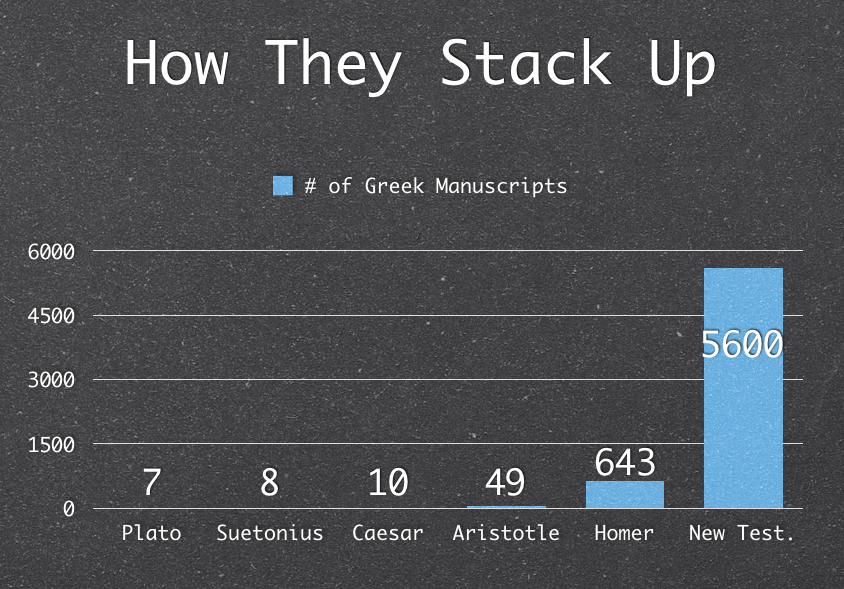
The New Testament has about 5,600 Greek manuscripts, or copies, to use in research. The next closest in Greek literature? Homer, with a whopping 643. Yes, read that sentence sarcastically. In fact, the writings of such highly touted philosophers like Plato and Aristotle have hardly anything of their own still kicking around, yet no one seems to question the authenticity or accuracy of their writings! If you include all of the manuscript evidence from the Old Testament as well, the number jumps up to the 25,000 range.
At this point, Bible scholars step in to do their thing. They are essentially tasked with laying out these 25,000 manuscripts (remember, no originals) and comparing them with one another to determine what the original text actually said. Because there are so many to compare and contrast – much more than any other ancient piece of literature – their task is actually a relatively easy one.
Bible scholars have two main things to help them in this process:
- They can compare the manuscripts by content. For example, if you have 99 copies of Romans that all say the same thing, and 1 copy that is different, chances are the 99 are more accurate.
- They can compare the manuscripts by date. For example, if one copy of Romans said one thing that another did not, they can date the two manuscripts to see which one is older. Chances are, the older the manuscript, the more accurate, because it is closer to the original source.
If you combine these two approaches, it increases your chances of determining the accuracy that much more.
What Are the Differences?
By some estimates, there are about 300,000 variations in the manuscripts. That may sound like a lot, but when you think that those 300,000 come out of 25,000 manuscripts, it means that about an average of 12 mistakes are found per copy. Also, about 95-99% of those variations fall under the category of nonsense errors, such as spelling mistakes. That means that any time someone misspelled a word, accidentally skipped a line, missed a word, accidentally doubled a word, or anything like that, it counts as one of the 300,000. And, remember, that every single one of these copies were done by hand. No photocopiers or printing press; just pen and parchment. How many mistakes do you think you would make in a gruelling process like that? If you had to copy out Isaiah by hand, do you think you might make 12 mistakes in the process? Seems likely!
Where the Trouble Starts
Of the roughly 300,000 variants, however, not all are accidents. A small percentage of them are more serious differences, such as the addition or omission of entire phrases or sentences. What are we to make of those? Scholars lay out the manuscript evidence they have and do their best to determine what the original text most likely said. Often, they can do this with a great deal of confidence. Occasionally, it is harder to figure out. In such cases, scholars go with what makes the most sense and then most modern Bibles place a footnote to inform the reader of the possible change in text. For example, these pictures are taken from my own Bible:
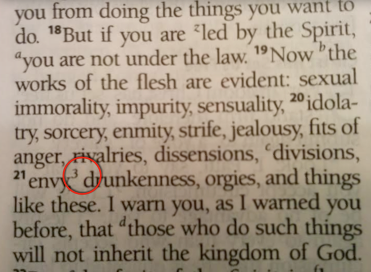

The first picture shows the text of Galatians 5:21, which clearly has a footnoted #3 next to the word “envy”. Skip down to the bottom of the page and notice the footnote says “some manuscripts add murder“. So, as scholars compared the manuscripts of Galatians, evidently some had the word “murder” listed in Galatians 5:21 while others didn’t. Scholars determined that omitting it was the most likely reflection of the original, but thought it was debatable enough to add the footnote that they could be wrong.
That means that not only is the English Bible you hold in your hand incredibly accurate, at the places where it is perhaps not people have been honest enough to tell you. Only a small fraction of the 300,000 variants are worthy to mention in footnoted form, because most are easily determined to be mistakes or blatant tampering and can easily be corrected. Pretty amazing, isn’t it?
The NIV vs. KJV
Back to the original question. Why does the NIV have a number of verses quite different from the KJV? The simple answer is this: since the KJV was published in 1611, we have discovered a lot more manuscripts of the Bible to add to the collection. For example, between 1946 and 1956, almost 1,000 new manuscripts were discovered in 11 caves along the coastline of the Dead Sea. It was one of the most significant archaeological findings of the 20th century.

These new manuscripts have allowed us to compare the ancients texts to one another with even more accuracy. And, not surprisingly, some things that the original KJV said were found to be not a likely reflection of the original text. So, modern translations simply updated the Bible to best reflect what we believe it to say based on the most up-to-date manuscript evidence. Those updates were:
- Relatively minor
- Relatively few
- An improvement of accuracy
In other words, the NIV (and other modern translations) aren’t taking away from the Bible or corrupting it. Instead, they are actually refining it and restoring it. Again, the Bible you hold in your hands is incredibly accurate!
What It Means
Simply put, you can trust your Bible, whether you are using an NIV or NASB or NKJV or NLT or ESV or whatever other modern translation you use. It is the Word of God, and has been amazingly preserved as such by God himself. If in doubt, remember that the accuracy of the Bible is more easily determined than any other ancient text 100x over. It is reliable, it is relevant, it is God’s revelation. Enjoy it as such!
 Canadian Bible Guy