
On Authority and Spheres of Governance
Posted on October 21, 2021 2 Comments

What does the Bible say about authority in general, and what does it say about government authority in particular? These are the questions this post aims to address. Scripture is not silent on these issues, and they are important ones we should grapple with so as to obey God’s Word in all areas of life.
The first thing that must be said is that God is not against authority. He himself has authority over the entire universe and exercises justly this authority. Psalm 103:19 says “The Lord has established his throne in the heavens, and his kingdom rules over all.” Jesus said in Matthew 28:18 “All authority in heaven and on earth has been given to me”. This should not be a controversial point for Christians. It is a fundamental tenet of Scripture that Jesus is Lord of all, and there is no inch of the universe over which he is not King. Thus, God endorses and enforces authority.
But what of earthly authority? It is one thing to say that the sinless, perfect God of the universe carries authority; it is quite another to say the same of sinful, imperfect men. Does God promote earthly authority, and if so, under what parameters?
It is human nature to resist authority. We firstly resist God’s authority over our lives. We want to determine what we will do apart from God’s will for us. But our resistance to authority doesn’t stop there. We also resist human authority. We don’t like anyone telling us what to do. We may justify this resistance by noting that human authority can be arbitrary, incompetent, and unjust. Human authority is often arbitrary in that the authority someone has or doesn’t have seems to be inconsistently applied. It can be incompetent in that many people with authority are not good at leading those under their supervision. And it can be unjust in that some abuse their authority to hurt others or advantage themselves. Aren’t these good reasons to reject human authority?
Again, Scripture must guide us. Just because human authority is not always carried out well does not mean the Christian worldview is against authority altogether. Quite the opposite. Scripture supports the role of human authorities and calls for them to be consistent, competent, and just. Failure to execute authority well does not negate the value of authority altogether; rather, it calls us to strive for better.
Human authority is ordained by God. It is part of God’s will and design for life on earth. Knowing that God is the King of all does not undermine this truth. This is because all earthly authority is delegated authority. In other words, the authority that men have on earth is not inherent to them. Rather, it is granted to them by God. Jesus himself said to Pilate “You would have no power over me if it were not given to you from above” (John 19:11). God delegates his authority to human authorities that carry it out on his behalf.
This is where the concept of sphere governance or sphere sovereignty comes in. God has ordained that society not be one large mish-mash of random individuals with no structure of authority, but rather an organized and interconnected web of different spheres of social dimensions of culture. Scripture, for instance, mentions at least four spheres of life and a delegated authority over each.
The first sphere is the individual. People are not merely part of collective wholes. They also exist as independent, autonomous individuals. God created human beings in his image not just generally or collectively, but also individually. Each person is given responsibility by God to live a godly life under his Lordship. The authority in the life of the individual is their conscience. God has given human beings an “inner compass” as it were, known as a conscience, that helps guide their decision making. Our conscience is a gift given to man by God to help us live as God would have us. When we are tempted, our conscience alerts us. When we sin, our conscience guilts us. When we do good, our conscience is clear. Though it is somewhat outside the scope of this article, Scripture speaks much about the role of our conscience. We can harden our conscience through ignoring it and persisting in sin (1 Timothy 4:2). Thus, it is not fair to say that our conscience is always right. We ought to bring our conscience under the Lordship of Christ and his Word. Sometimes we damage our conscience, ruining its proper function. But doing something against our conscience is considered a sin by Scripture (Romans 14:22-23).
This is why personal freedom is a high value in cultures that have been influenced by Christianity. In the Canadian Charter of Rights and Freedoms, the freedom of conscience is the first protected right under the law. Why is that? Because forcing people to do things against their conscience is both coercing someone into sin and aiming to override God’s chosen means of individual governance. God gave us consciences. We should be very slow to resist that. The founders of Canadian law (and even more explicitly, American law) understood the importance of individual conscience. This insight they gleaned from Scripture.
The personal conscience, however, must not be the only governing authority in society. Such a viewpoint is seen in Scripture during the time of the judges, where the Bible tells us that “in those days there was no king in Israel. Everyone did what was right in his own eyes” (Judges 21:25). Even a surface reading of the book of Judges reveals that chaos was the end result. This political philosophy, known in modern times as strict libertarianism, is unscriptural. This is because the Bible outlines other spheres of governance where authority from God is given.
The second sphere is the family. The family unit is not a Western social construct as many modern educators assert. Rather, it is a God-ordained means of organizing society. Right from the beginning of creation we see God bringing together a man and woman in marriage, with the design that they will bear children and become a family unit (Genesis 2:24, 1:28). Later, those children will age and splinter off to create new family units. This is the first and most fundamental communal grouping of human beings.
In the family unit, God’s authority is delegated to the parents. Exodus 20:12 tells children to “Honor your father and your mother”. Rebellious children become a grief to both fathers and mothers (Proverbs 10:1). Even beyond this, Scripture places a particular emphasis on the husband/father to be the primary leader in the home. Ephesians 5:23 makes it clear that “the husband is the head of the wife as Christ is the head of the church”. Furthermore, the consistent pattern of Scripture reveals the husband/father to be the representative of the family unit in both family and community affairs.
Once again, the fact that parents in general and fathers in particular do not always exercise their authority well does not mean God hasn’t still granted them that authority. Scripture never negates the authority of parents; rather, it calls on parents to exercise authority in godly ways (Proverbs 22:6, 29:15, Ephesians 6:4).
The third sphere is the church. The church of Christ does not exist as an individual person, nor does it exist as merely a family unit. Rather, it is a collective of individuals (that may or may not be part of the same family unit) that make up a unique and distinct entity, that being, the household of God. 1 Timothy 3:4-5 tells us that an overseer “must manage his own family well and see that his children obey him, and he must do so in a manner worthy of full respect, for if someone does not know how to manage his own household, how will he care for God’s church?” This verse clearly notes that a church family is larger than a single family unit. The two are not the same.
This same passage also notes that God’s delegated authority for the church are elders or overseers. Scripture uses the terms “elder”, “overseer”, “pastor”, and “shepherd” virtually synonymously. They all refer to the same office. These references are also always in the plural, meaning that local churches are not lead by one “pastor”, as is the model in many North American churches. Rather, they are local bodies led by a plurality of pastor/elders who function as a team. Hebrews 13:17 clearly states that God’s authority is delegated to these church leaders: “Have confidence in your leaders and submit to their authority, because they keep watch over you as those who must give an account. Do this so that their work will be a joy, not a burden, for that would be of no benefit to you.”
Note the phrase “submit to their authority”. Local churches have leaders with authority. However, this authority (like the other spheres) is not without qualification. These leaders should lead “as those who must give an account”. This implies that their leadership will be judged by God as a right use of authority or a wrong use of it. Some authority is godly, some is not. Again, there is a temptation among many Christians to see the abuse of authority within churches and presume that God must not want any leaders with authority in the church. This is a false conclusion. Scripture plainly states that the antidote to ungodly authority is not no authority at all, but rather the godly use of authority. The Bible makes many other references to the need for church leaders to be men of character who use their authority well (1 Peter 5:1-5, 1 Timothy 3:1-16).
The fourth sphere is the civil government. The government (ie. “the state”) is another area of society to which God has delegated his own authority. Romans 13:1-2 is strikingly clear on this point: “Let everyone be subject to the governing authorities, for there is no authority except that which God has established. The authorities that exist have been established by God. Consequently, whoever rebels against the authority is rebelling against what God has instituted, and those who do so will bring judgment on themselves.” Paul clearly understood that governing authorities are not a human cultural experiment. Rather, they are instituted by God himself. Government is God’s idea—even human government. Such authority is established by God.
The continuation of this passage (verses 3-7) reveals God’s purpose for human government. It exists to punish evil and promote good. Therefore, government authorities are called “God’s servant” on earth, those who carry out God’s punishment on evildoers. 1 Peter 2:13-14 elaborates even further: “Submit yourselves for the Lord’s sake to every human authority: whether to the emperor, as the supreme authority, or to governors, who are sent by him to punish those who do wrong and to commend those who do right.” This verse notes that human governments often have various levels to them, with some authority being “higher up” and others carrying out a “boots-on-the-ground” role. Today we would include presidents and prime ministers all the way down to local police and everything in between. All levels of authority are to be respected and obeyed. Again, government authority is put in place by God to serve his purposes of punishing the wrongdoer, and so it remains under his ultimate Lordship. There will be times and places when government authority should be resisted if Lordship to Christ is to be maintained. For more on the details of disobeying government authority, a future post is coming.
It is worth noting that our current model is significantly different than that of Old Testament Israel. In those days, Israel functioned as the people of God and a literal earthly state combined. This is known as a theocracy, somewhat similar to what we might call today a “state-sanctioned religion”. In such a scenario, the inhabitants of a state were under the rule of a state religion whether they wanted to or not. The laws of the land were directly connected to the state religion. With the coming of Christ, the Old Testament theocracy model was disbanded and the Church and state were separated. God no longer rules as King through only one nation on earth. Rather, his Kingdom is currently a heavenly one that rules in the hearts of his people who are scattered over every nation of the earth.
There may also be other spheres of authority. The primary one that comes to mind is that of the workplace. Scripture, for instance, calls on slaves to obey their masters (Ephesians 6:5-8, Colossians 3:22-25). It also calls on masters to treat their slaves with dignity (Ephesians 6:9, Colossians 4:1). While slavery is not an accepted modern-day institution, perhaps a comparable model would be that of the modern workplace. Workplaces have both employers and employees, and generally Christians have accepted that employers have delegated authority to tell their employees to do what they were hired to do. These passages on slaves and masters have often been used to speak to the relationship between employers and employees. It should be noted that some forms of ancient slavery closely resembled modern forms of employment, far more than the images of race-based chattel slavery such as would be commonly pictured in the United States. Again, another post for another time.
What is the purpose of outlining these spheres of authority? If we are to have a Scriptural worldview, then we must allow the Bible to guide our thinking. The Bible outlines various structures in society and different means God has put in place of governing those structures. He has ordained the conscience to govern the individual, fathers to govern families, elders to govern the church, and kings/magistrates along with appointed law enforcement to govern the civil realm. The reason many theologians have called these “spheres” of governance is that each appointed authority should largely remain inside its own sphere. Practically speaking, it is not the role of elders to govern a family unit. Neither is it their role to govern the affairs of another church body. It is not the role of the state to govern local churches. Neither is it the role of the state to govern the people of another jurisdiction. It is not the role of one person’s conscience to govern the conscience of another. And so on and so forth. These actions violate God’s order for society. Each God-appointed authority must remain in its God-appointed role governing its God-appointed sphere of life, ideally to its God-appointed outcome.
This does not mean that governing authorities will never overlap. Perhaps “overlap” is not even the right word to use since it implies that everything laid out in the above paragraphs is erasable under certain circumstances. Let me try to put it differently. Situations may arise where one governing authority will be forced to override another governing authority and would be right to do so. For instance, if a child is being harshly abused by his parents, the state should intervene in that situation. This would not fairly be described as operating outside of their God-given bounds, but actually operating within their God-given bounds, since they are called to punish the evildoer. This is not so much an “overlap” as it is the proper relationship between connected spheres.
Remember that for this to work best, we must begin with the foundational premise that all authority is God’s authority. Any human authority that exists is not inherent; it is delegated to them from God. Human authority does not get to determine their own goals and bounds. Rather, those goals and bounds are dictated by God. Without this starting point, all human authority eventually devolves into a war-zone between competing groups of power. This is precisely why human authority is often so disastrous. As the perspective of authority and society becomes more secular and disconnected from God, those in authority are more likely to pridefully govern by their own whims rather than in humble submission to God. Again, is the fact that authority is often so ungodly a good reason to discard it altogether? No. Rather, we must fight to bring all human authority under the authority of God as he intends.
One practical question might arise. How exactly should we “fight” for this viewpoint? How do we fight for a society that is governed in a way that God would desire, while we live among an increasingly secular culture? Should Christians try to force all of society to submit to God’s rule? Some Christians have indeed made this attempt in the past. However, nowhere in Scripture are believers called to advance God’s Kingdom through force. Efforts to do so either lead Christians to force their views onto the conscience of individuals (violating their free will) or erroneously merge the Church and state into one entity (a forced theocracy).
So, what can we do? Our first and primary order of business is always to share the gospel and allow the Spirit of God to turn people’s hearts toward Christ and his Word. A society where revival takes place will naturally develop a more biblical approach to culture and governance because enough of its own people voluntarily value it. If many people in a given region come to faith, it will have a major trickle-down effect on the beliefs, values, entertainment, education, and leadership of that region. It will become more in-tune with God’s Kingdom by default.
A second, and just as vital (if not more so) action is to pray. We should pray for revival. Psalm 85:6 says “Will you not revive us again, that your people may rejoice in you?” We should pray for strong families. Malachi 4:6 says “And he will turn the hearts of fathers to their children and the hearts of children to their fathers”. We should pray for our churches. Ephesians 6:18 says we should make “supplication for all the saints”. We should pray for God to turn the hearts of government leaders. Proverbs 21:1 says “The king’s heart is a stream of water in the hand of the Lord; he turns it wherever he will.” Lastly, we should obey Jesus in Matthew 6:10 by praying “your kingdom come, your will be done, on earth as it is in heaven.”
There certainly are other actions we can take. I will detail those in a future post. But I believe we should not lose focus on our first priority which is the power of the Word and prayer. Through the unleashing of these we can demonstrate to the world the wisdom and ways of God which will ultimately lead to human flourishing.
Dealing With the Fear of Death
Posted on October 19, 2021 2 Comments
If the era of COVID has taught us anything, it is that people are terrified of death. We already knew this, of course, but the pandemic thrust our mortality into the limelight in a way that we aren’t normally confronted with. Much of our culture has sanitized death to the point that we largely ignore it. Sure, we all know that we will die one day, but we don’t really like to think about it very much. When that reality becomes inescapable, we panic, because we are—pun intended—scared to death of death.
Why are we so afraid to die? I’m sure there are many layers of answers to this question. We are afraid to leave those we care about. We are afraid that we will be forgotten. Probably most of all we are afraid of the unknown. What is death like? Will it be painful? Will it be blissful? Is it the end of us? Is there something on “the other side”?
The fear of death is very natural. I would go as far as to say it is God-given. It is God-given in at least two senses. Firstly, we fear death because it contradicts the way humans were created. We were created by God to live, not to die. The creation account in Genesis describes a world where death does not exist—only life. I believe part of the reason we fear death (or at least resist it) is because it is a reflection of the human impulse to live forever, as God designed us to do.
There is, however, a second reason that fear of death is natural. Ecclesiastes 3:11 tells us that God has “set eternity in the human heart”. I take this to mean not only that we yearn for eternal life, but also that deep down we know it exists. In our heart of hearts we know that death is not the end, but rather the transition into the next life where we will meet God face to face. The reality of meeting God face to face is scary, and rightly so. Hebrews 10:31 tells us that “it is a dreadful thing to fall into the hands of the living God.”
We anticipate that meeting God is dreadful because we know that no pretence will save us then. God will be there whether we believed it or not. God will exist as he really does, not as we thought he exists. And God will judge us according to who and what we really are, not who or what we pretend to be. Hebrews 4:13, “Nothing in all creation is hidden from God’s sight. Everything is uncovered and laid bare before the eyes of him to whom we must give account.” Deep down we know this is the case, and it terrifies us.
It terrifies us because it should terrify us. We are afraid to die because we are afraid to face God. In life we use convenient phrases like “no one’s perfect” or “we’re all a work in progress” to deflect guilt from ourselves for our own failings. We appreciate that they are, for the most part, culturally-accepted reasons to live with our flaws. But will that attitude fly with God?
The answer is no. The message of Scripture is clear and straightforward: “Repent and believe in the gospel” (Mark 1:15). These words, spoken by Jesus himself, summarize God’s command to the world. We must repent for our sin and believe in the saving grace of Christ. The word “repent” means to “turn around”. It implies that humanity is going in the wrong direction at present. The way we are going is the path of self-autonomy. We want to reject God’s rulership in our lives and become our own gods. This is the fundamental sin of us all, the sin that is under every other sin. This prideful rebellion against the reign of God in our lives has put us at odds with our Creator. We have made ourselves his enemy. Therefore we must repent.
But if we are to turn away from sinful rebellion, what are we turning to? Jesus said it himself, “the gospel”. The gospel, which literally means “good news”, is that God forgives sinners like you and I. He offers this as a free gift of grace that we receive by faith. We don’t earn God’s forgiveness through good deeds. Rather it is free for the taking to all who trust in Christ as their only hope. You cannot put your hope in yourself because you are not righteous. Jesus Christ died for the sins of the world. 1 Peter 3:18 says “For Christ also suffered once for sins, the righteous for the unrighteous, to bring you to God.”
Our relationship with God is restored through the gospel. No longer do we need to dread seeing God face to face. Rather, we can actually look forward to and long for that day, because we have been made right with God and have nothing to fear. All who have repented of their sin and trusted Christ as Saviour and Lord do not need to fear death. Philippians 1:22 tells us that “to die is gain” for the believer. Death is an upgrade for the Christian. It is to leave the suffering of this world for an eternal future of blessing with God. For those who are still in their sins, death is not gain. It is to fall under God’s righteous condemnation for eternity. That is what we fear about death. But it need not be that way.
I am going to die. You are going to die. We all will. The sooner we face that reality, the better. And the sooner we actually deal with it, the better. I have chosen to obey the call of Jesus to repent and believe the gospel. Because of that, the fear of death does not control me. But this world is crippled by fear of death. The world needs a hope beyond the human measures we can take to stave off the inevitable. You can prolong your life many ways, but you can never secure it forever—not through human means, at least. But God does offer eternal life for sinners who repent and believe in him. In that there is an unshakable hope that no trouble of this life can upset.
John 3:16-18 “For God so loved the world that he gave his one and only Son, that whoever believes in him shall not perish but have eternal life. For God did not send his Son into the world to condemn the world, but to save the world through him. Whoever believes in him is not condemned, but whoever does not believe stands condemned already because they have not believed in the name of God’s one and only Son.”
Book Review: Fault Lines by Voddie Baucham
Posted on June 29, 2021 Leave a Comment

Christianity and Critical Social Justice: These two things cannot co-exist.
This is the primary message of Voddie Baucham’s latest book Fault Lines: The Social Justice Movement and Evangelicalism’s Looming Catastrophe. Just as the San Andreas Fault creates a stark dividing line between two moving tectonic plates, so a dividing line is splitting down the middle of Christian Evangelicalism, creating a divide between those who embrace the modern ideas of social justice and those who don’t.
Baucham says “The Critical Social Justice Movement is vast. Its influence is broad and deep within evangelical circles. And as that influence grows, it is causing some among us to make alliances we never would have forged in the past. A lot of it has to do with the fact that we are afraid to be called racist or end up ‘on the wrong side of history’ on the race issue. Unfortunately, some have found themselves on the wrong side of the present.”
The book is divided into several sections, including Baucham’s personal story of living as a black Christian in America, a comparison of justice as defined by Scripture vs. the modern culture, numerous examples of Evangelicals embracing Critical Theory, and data-based analysis of systemic racism in America, among other things. Woven throughout the book is the same overall warning, that North American Christians need to reject the modern Critical Social Justice movement as antithetical to Scripture, or else it will have toxic and heretical results.
Importantly, Baucham goes to great lengths to differentiate between justice as outlined in the Bible and the social justice movement of our day that is founded upon the ideas of Critical Theory and Intersectionality. Baucham advocates for justice, to be sure, but only the kind that Scripture advocates for. He states “Beyond confronting falsehoods in general, our pursuit of justice must also be characterized by a pursuit of truth. Much has been said recently about seeking justice, and I could not agree more. However, we must be certain that we pursue justice on God’s terms.”
As outlined in the book, there are many serious problems with Critical Social Justice that make it incompatible with Christianity. For instance, Critical Social Justice:
- Functions as a worldview that threatens to overtake one’s Christian worldview
- Undermines Scripture as the source of truth, and instead sees the voice of marginalized people as sources of truth
- Wrongly characterizes people by their group identity instead of their personal character
- Undermines the power of the gospel as the means to transform lives
Each of these claims, among others, are fleshed out at length in the book. Baucham does a good job of citing primary source material to avoid making straw-man arguments and uses straightforward logic and biblical interpretation to make his points. As someone who is well-researched on these issues myself, I see very few flaws in his efforts.
It should be noted that Fault Lines is written specifically to the Church. Baucham is not interested in correcting the beliefs of unbelievers, but freeing believers from being tainted by worldly ideas. His challenge is specifically to Christians to reject the ideas of Critical Social Justice and instead remain steadfastly anchored to the truth of God’s Word. To demonstrate the importance of this, he cites numerous examples of evangelical Christians adopting a Critical Social Justice mindset and scrutinizes those ideas against the Bible. This analysis demonstrates that the ideas of CSJ are not able to co-exist with a Christian worldview.
Perhaps this paragraph best summarizes the books material: “This book is, among many things, a plea to the Church. I believe we are being duped by an ideology bent on our demise. This ideology has used our guilt and shame over America’s past, our love for the brethren, and our good and godly desire for reconciliation and justice as a means through which to introduce destructive heresies. We cannot embrace, modify, baptize, or Christianize these ideologies. We must identify, resist, and repudiate them. We cannot be held hostage through emotional blackmail and name-calling. Instead, we must ‘see to it that no one takes you captive by philosophy and empty deceit, according to human tradition, according to the elemental spirits of the world, and not according to Christ’ (Colossians 2:8).”
In Fault Lines, Baucham pulls no punches. He names names and specifically points out the errors that he sees taking over the Christian Church. On the whole, I wholeheartedly agree with him. I think his logic is sound, his biblical exegesis orthodox, and his cultural analysis astute. The book is sure to ruffle some feathers, but it seems a necessary thing to do as Christian evangelicalism is indeed headed for a major schism. I think he’s right about that. A break is coming in the not-too-distant future within the North American Church, and it will be over the issues related to social justice. These beliefs matter significantly, and so we need to understand them and weight them against the Word of God. If you’re interested in a book that will help you consider these things for yourself, Fault Lines is for you.
Where Do You Draw the Line?
Posted on May 4, 2021 Leave a Comment
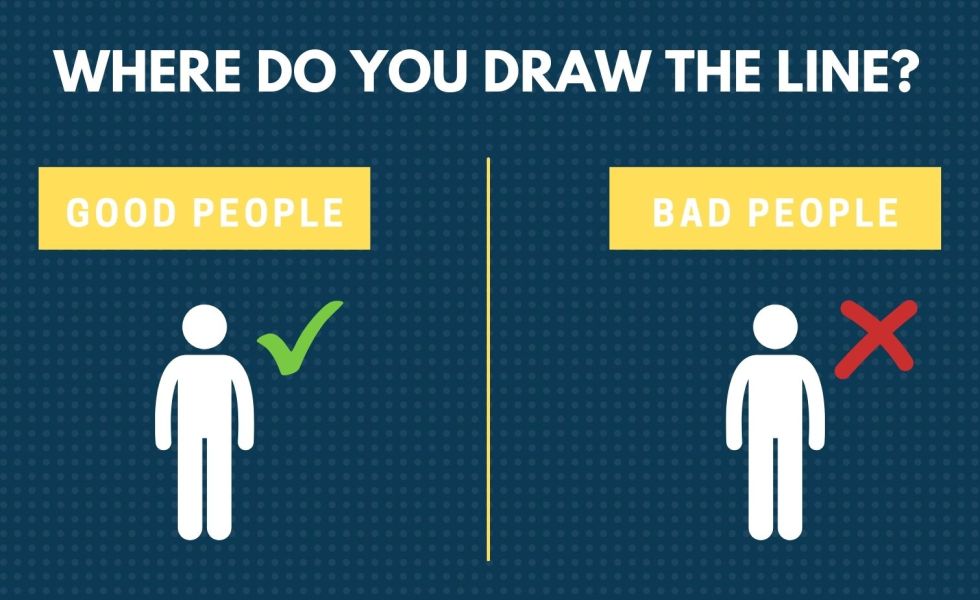
People think in terms of categories. We can’t help it; it’s part of human nature. Categories help us to organize the world in a way that makes sense and allows us to (hopefully) make useful decisions within that framework. Because our minds tend to work this way, we categorize not only things or events but also people. One of the primary ways we categorize people is morally, along some kind of good-bad spectrum.
Put simply, we tend to think that there are good people in the world and bad people in the world. Most people, I think, would likely place the majority of the human population into the “good” category and leave the “bad” label for individuals who seem particularly deserving: murderers, rapists, extortioners, racists, and the like. I think it is also true that the average person would tend to put themselves in the “good” person category. This good-bad spectrum probably places someone like Mother Theresa on one end and Adolph Hitler on the other. Everyone else falls somewhere in between. Yet even on this ranging spectrum, in our heads we still put a line somewhere that crosses over from the good side to the bad side. There might be a handful of people we’re not sure which side they belong on, but most everyone else we can deduce pretty quickly. The million dollar question is: where do you draw the line? How can you know if someone is a good person or a bad person, objectively?
It may not be exact, but this basic structure exists in the mind of every person because every person has a worldview. It doesn’t matter what your worldview is, you apply it to the people around you, knowingly or not. All of us have some sort of concept of what traits are ideal in human beings, and then we assess other people based on how they line up to those ideals. This is true for both secular people and religious people.
Try not to overthink it. If someone were to ask you, “Do you consider yourself a good person?” immediately your mind would develop some kind of idea of what a good person would be like (either something you’ve hashed out before or here on the spot) and then you’d evaluate to see if you meet those qualifications. What I am asking you to ponder is, how do you know where to place the line? What qualities would make someone good or bad? How you answer these questions changes a lot about how you interact with others and orient yourself in the world.
I raise this issue not only because it is fundamental to how we live our lives, but also because I think most of us think about this issue in completely the wrong way. Most of us place the line somewhere in the middle of humanity and either put most people on the bad side (if you’re more cynical about the human condition) or most people on the good side (if you’re the average person living in the 21st century). And unless you have some serious regrets about your past, you probably consider yourself to be a good person.

But what if you’re completely wrong? What if this whole way of thinking about morality is off-base? Here’s the thing—from a Christian perspective, this way of thinking is wrong by a country mile.
According to the Bible, the line between good people and bad people is placed directly in between morally perfect and morally imperfect. Jesus says in Matthew 5:48 “you are to be perfect, even as your Father in heaven is perfect”. The dividing line is perfection. This means that our assumption about where the line should be is likely wrong by a long shot. Almost no one considers literal moral perfection to be the definition of a good person. We all assume that people can still have flaws and be a good person. After all, we say, “no one’s perfect”. But this is not at all how God thinks about this issue.
To further illustrate, consider the assessment of humanity from Romans 3:23, “all have sinned and fall short of the glory of God”. What this passage teaches us is that every person on the planet “falls short” of the standard God holds us to because of our sin. Thus, from God’s vantage point, the entire human race is on the “bad” side of the line. This would further be proven by the words of Jesus in Mark 10:18, “no one is good except God alone.” What this reveals is that the way God sees the world has every person on the “bad” side and God alone on the “good” side. Even though we may not see it this way, this is true assessment of how things really are.

The implications are significant. The Bible is challenging your own self-evaluation that you are a good person and saying, in fact, that you are not a good person. It says this not only of you but everyone else as well. If this is true, and God alone is good, it should greatly alter the way we see ourselves and others around us!
In fact, this is the foundation of the Christian worldview. The starting point of the Christian faith is the sinfulness of man and the holiness of God. We are bad, God is good. And because God is ultimately the One who will judge us in the end, he has given us indication ahead of time that we’re in a lot of trouble. He won’t declare us good, even if we think we are. He will declare us sinners who have fallen short of his standard for our lives and held accountable for our wrongdoing.
This is why Christians put such emphasis on sin. It reveals the perilous situation in which we find ourselves. It is also why Christians put such emphasis on Jesus as our Saviour, because it reveals our only hope for resolution. We can’t move from the bad side of the line to the good, because we’ve already sinned and can’t undo it. But what we can do is have our sins forgiven. In other words, we can’t become good people but we can become forgiven people. These are not the same thing but they are the difference between self-righteous religion and true Christianity.
Several things happen when we think this way, in accordance with the truth:
- We don’t think of ourselves as better than anyone else.
- We recognize that the forgiveness that God offers through Jesus is absolutely essential and our only hope.
- We will reject philosophies that encourage us to think in terms of a “us=good, them=bad” mentality.
As I see it, all three of these are current problems that need overcoming.
Firstly, human pride is rampant. This is not unique to anyone in particular, but all people tend to gravitate towards this viewpoint. We like to elevate ourselves at the expense of others. We tend to think if we were in charge, things would go better. We think the people around us are stupid, lazy, or not as capable as we are. This kind of thinking is poison to the soul and the Bible teaches that those who think this way will be condemned by God (Luke 18:9-14).
Second, forgiveness is our greatest human need, not self-improvement. All secular philosophies and non-Christian religions offer some variation of self-improvement designed to bring us into the “good” side and maybe even shoot us past other less-good people. This is a fools errand because, as Scripture noted earlier, we all “fall short” of who we are supposed to be. No amount of self-improvement will make a person acceptable in the eyes of God. Perfection is the only standard and is an unattainable one. Therefore, the person who realizes this truth will be quick to seek God’s forgiveness rather than pursue the futile path of self-improvement.
Thirdly, the typically-used good-bad spectrum wreaks havoc in our personal lives and in the world around us. A good-bad mentality is another variation of divide-and-conquer. It breaks the people of the world into unnecessary categories that create division, disharmony, and pride. It causes people to judge others based on their own arbitrary standards of goodness and pridefully wish others were more like them. “If only people were more like me, the world we be a better place!” we foolishly think. Nah. You’re a contributer to the misery in the world like everyone else.
Here’s the point: if we start off with a faulty foundation, we will build a tower destined to crumble. Trying to slice up the world into good and bad people is a mistaken endeavour that is rooted more in our own sinful pride than in reality. Instead, we should see the world and ourselves the way God does, with him alone as perfect and all others, including ourselves, on the side of failure and imperfection. Only when we do this can we orient ourselves to God and others rightly and begin to develop a coherent, biblical, and life-giving worldview.
Is Being Colourblind the Answer?
Posted on April 21, 2021 3 Comments

What is the path to healing in our racially divided world?
This is one of the most important questions our modern society needs to answer. The current solution that is being offered comes from a Critical Race Theory perspective. CRT, as I have written about before, is a philosophy that understands culture to be inherently racist from top to bottom. Popular proponents of CRT teach that racism is normative and so embedded into the customs of society that if someone simply lives an average life, they are actually perpetuating racism without even knowing it. Thus, CRT proposes that in order to fix the racism in society we must raise cultural awareness of racism and seek to actively undo it.
It is important to understand that Critical Race Theory fundamentally encourages people to both (a) see race and (b) value it greatly in decision-making. The following are some examples of significant cultural voices stating this in plain terms:
“Critical race theorists hold that color blindness will allow us to redress only extremely egregious racial harms… Only aggressive, color-conscious efforts to change the way things are will do much to ameliorate misery.” -Delgado and Stefancic, Critical Race Theory: An Introduction, p. 22.
The argument here is that a colourblind approach to race issues will only see obvious racism but fail to notice it in more subtle forms. Therefore, it is said, the real way to address racism is to be intentionally more conscious of people’s skin colour and the dynamics around it.
“The idea of a color blind society, while well intentioned, leaves people without the language to discuss race and examine their own bias…Color blindness relies on the concept that race-based differences don’t matter, and ignores the realities of systemic racism…[color blindness] helps to uphold racism instead of rendering it powerless” – Oprah Daily Magazine.
Again, the argument here is that being colourblind allows racism to flourish unchallenged, rather than reducing its power. Being colourblind is said to be counterproductive, actually upholding racism while claiming to diminish it.
“The only remedy to racist discrimination is antiracist discrimination. The only remedy to past discrimination is present discrimination. The only remedy to present discrimination is future discrimination.” – Ibram X Kendi, How to Be an Antiracist, p. 19.
Lastly, this line of thinking is similar in that Kendi argues that the colourblind approach (which is an attempt to stop discrimination) is not preferable. Instead, he contends that the way to combat racism to be intentionally discriminatory towards white people so that past discriminations against people of colour can be corrected. Again, you see that he is advocating for seeing people’s skin colour as significant and treating them differently on purpose because of it.
To summarize, the mainstream cultural narrative around racial issues promotes intentionally seeing a person’s skin colour as an essential component of their identity and treating them accordingly. If you are white, you should be discriminated against to reduce your white privilege. If you are a person of colour, you should be given special treatment to make up for past ills committed against your race by whites. This line of thinking explicitly rejects the approach of being colourblind and promotes the idea of being colour-conscious in its place.
Let’s define our terms here. Being “colour-conscious” simply means treating a person differently according to their race—specifically, granting them advantages if they are a minority and disadvantages if they are white. It means that you are aware (ie. conscious) of their race and what that means historically for the way society has treated them in the past.
On the other hand, “colourblindness” is often characterized simply as “not seeing race”, which gives off the false impression that people are claiming to literally not notice the skin colour of individuals. This is not true in practice or in principle. Obviously anyone with functioning eyes can see skin colour. Claiming to be colourblind isn’t saying otherwise; rather, it is claiming to not allow a person’s skin colour to influence how one thinks of or treats other people. Being colourblind is a “term used to describe personal, group, and institutional policies or practices that do not consider race or ethnicity as a determining factor. The term ‘colorblind’ de-emphasizes or ignores race and ethnicity as a large part of one’s identity” (source).
What we have here are two significantly different approaches to the same problem—polar opposites, in fact. If we want to rid society of racism (and what moderately moral person doesn’t?), then we must decide between a colourblind approach or one that rejects colourblindess in favour of colour-consciesness that (in Kendi’s words) is intentional “discrimination”.
My contention is that the “old” way of being colourblind is absolutely the right approach to take. I believe this for three reasons.
The first Scriptural. The common values that “it’s what’s on the inside that counts” and “don’t judge a book by its cover” are consistent with biblical teaching. Perhaps the most prominent example comes from 1 Samuel 16. In this passage, God is choosing who will be the king of Israel among the sons of Jesse. Samuel takes one look at Eliab and immediately assumes he will be the chosen one, but God rejects him. He explains why in verse 7, “Do not consider his appearance or his height, for I have rejected him. The LORD does not look at the things people look at. People look at the outward appearance, but the LORD looks at the heart.”
The dichotomy is clear. Putting value into the things we can physically see about people is a human way of thinking. God does not operate this way. God looks past the surface to see the inner person. Though not explicitly stated in this passage, it is implied here and elsewhere that this is a value we should adopt from God. If we are to grow in godliness (ie. becoming more like God and his character), then it follows logically that this would be one aspect of that growth.
Again, being colourblind does not mean that you literally don’t see physical features such as race. It means that they carry little to no value in how you treat others. It means that you care more about who they are as a person than what they look like. If this is how God himself operates, then so should we. Intentionally seeing race in order to intentionally discriminate is absolutely antithetical to a Christian worldview and should be rejected by believers.
This line of thinking would be supported by numerous other passages. The parable of the good Samaritan comes to mind. It is well-known that Jesus chose a Samaritan to be the one who helps the beaten Jew specifically because these two people groups hated one another. Jesus is demonstrating that we are to love our neighbour no matter how different we perceive them to be. Many other Scriptures would contend similarly, that the hostility between people groups is broken down by the love of God so that we no longer treat each other differently or as less-than but rather love one another. This is basic Christian doctrine.
The second reason for accepting colourblindess is historical. Perhaps the most famous line from Martin Luther King Jr.’s famous speech is “I have a dream that my four little children will one day live in a nation where they will not be judged by the colour of their skin, but by the content of their character.” There is a reason this sentence has had such an enduring impact on society. It resonates with godly values and common sense logic. It is the obvious antidote to discriminating against people because of their skin colour. It elevates our shared humanity and makes us all equals in the sight of God and others, as it should. Though modern so-called experts on racism would absolutely contest this, I see it as undoubtedly true MLK’s vision made huge strides for the advancement of Civil Rights and the erosion of racism in society. No better example exists than that of children, who don’t seem to care one bit what another child looks like so long as they enjoy each other’s company and treat each other well. The fact that this ideal is increasingly being seen as a weakness, and that we are now training children to see and care about the skin colour of others is completely backwards and appalling.
The Civil Rights movement was based on seeing all men as equal. This helped to end segregation and start to bring together the races. Though there is still much work to be done, it laid the foundation for that to happen. Racism still remains an issue, to be sure, but to deny that being judged by character rather than skin colour has made things better is a conclusion outside the bounds of reality. Society is better off when that kind of value is embraced and lived out.
I want the reader to understand that the current approach to race issues (informed by CRT) is absolutely not the continuation of the Civil Right’s movement. It is actually the undoing of it. It is taking the core value of MLK and turning it on its head. It is teaching people to judge by skin colour and not by content of character. It is, as Kendi explicitly stated, fighting past discrimination with present and future discrimination. For this reason it must be rejected.
The third reason, as I have alluded to already, is moral. It is morally backward to encourage people to see and judge others by skin colour. It is morally backward to teach people to fight discrimination with more discrimination. It is not killing racism to care a lot about people’s skin colour; rather it is fuelling it. Put simply, embracing the core tenets of Critical Race Theory as mainstream society has done is promoting immoral values that will ultimately be destructive, not constructive. It functions as a form of divide-and-conquer rather than fostering togetherness and unity.
Consider what Scripture has to say about the right response to evil in Romans 12:14-21:
[14] Bless those who persecute you; bless and do not curse them. [15] Rejoice with those who rejoice, weep with those who weep. [16] Live in harmony with one another. Do not be haughty, but associate with the lowly. Never be wise in your own sight. [17] Repay no one evil for evil, but give thought to do what is honorable in the sight of all. [18] If possible, so far as it depends on you, live peaceably with all. [19] Beloved, never avenge yourselves, but leave it to the wrath of God, for it is written, “Vengeance is mine, I will repay, says the Lord.” [20] To the contrary, “if your enemy is hungry, feed him; if he is thirsty, give him something to drink; for by so doing you will heap burning coals on his head.” [21] Do not be overcome by evil, but overcome evil with good.
Simply lay this passage of Scripture next to the quotes given above by those who advocate for fighting discrimination with more discrimination and you can see the moral dilemma. Attempting to overcome evil with more evil is wrong. The only way to overcome evil is with good. Being intentionally discriminatory in order to try and correct past wrongs is not blessing those who curse you or overcoming evil with good. It is trying to avenge yourself, and is in direct contrast to the Word of God.
For these reasons every Christian (and hopefully more of secular society) must reject the philosophies of Critical Race Theory. In place, we should embrace the Scriptural values of treating others the way we want to be treated, caring for them as individuals and common members of the human race, judging people based on their character and not their skin colour, and returning good for evil. This is the path forward. This is the path to healing. I pray more people realize this and resist the current sway of culture that is ultimately leading to death.
5 Simple Ways to Disciple Your Children
Posted on March 29, 2021 1 Comment

The highest calling for every Christian parent is to raise their children to love and serve the Lord. Yet many Christian parents struggle to know how to actually accomplish this task. Unfortunately, this has led some to essentially leave it in the hands of the church to do for them. We bring our kids to Sunday School, midweek ministries, youth group, and summer camp, and then hope that everything turns out in the end. There is absolutely nothing wrong with any of these things, and I would argue they are incredibly helpful assets in our task of discipleship. But Scripture calls parents to take a more active role in this process. Deuteronomy 6:6-9 states:
[6] And these words that I command you today shall be on your heart. [7] You shall teach them diligently to your children, and shall talk of them when you sit in your house, and when you walk by the way, and when you lie down, and when you rise. [8] You shall bind them as a sign on your hand, and they shall be as frontlets between your eyes. [9] You shall write them on the doorposts of your house and on your gates. (ESV)
These verses lay out at least two important principles. First, it is the job of parents to raise their children in the faith. It cannot be something we merely export out for others to do. Second, this is an ongoing, natural process. In the passage, we see parents interacting with their children over the natural course of a day. We also see that it is not a one-time conversation. Discipleship happens in the context of the parent-child relationship.
With this in mind, I offer a few practical suggestions to help in this regard.
(1) Read the Bible with your kids daily
The foundation of our faith is God’s Word, and children should be exposed to it at home as well as in church. Reading the Bible at home shows children that our faith is not something sectioned-off for Sunday mornings but rather fills our entire lives. In our house, we have formed the habit of reading the Bible at dinner time, since everyone is gathered together already. There is no need for adding another meeting to the day. We simply read a section, ask a question or two, and leave it at that. Sometimes there is little engagement, and other times it goes really well. I don’t worry much about the results from day to day, since establishing the priority of Bible reading and reflection is itself a worthy goal.
(2) Pray with your kids
No surprise here. Most Christian parents already pray with their children regularly. But if this is not yet a habit you have formed, start today. Praying with your children is incredibly valuable. You can do this at bedtime with younger children every day. Once kids are a bit older and are no longer being tucked in at night, it may be harder to find opportunities, but don’t let that deter you from finding a way anyways.
One thing we forget about praying is that it is an opportunity to show kids what a relationship with God looks like. Children naturally pray for things they want, like a new toy or nice weather on the weekend. That’s perfectly fine, but we want their prayers to mature over time. We can do this by modelling what spiritually mature prayers can sound like. When you pray with your children, incorporate things like:
- giving thanks for the day
- asking for growth and wisdom
- praying for the salvation of friends and family
- asking to grow through a hardship, rather than simply taking it away
- asking for opportunities to serve others
- praying that we would be more obedient to God
You can actually teach a lot of sound theology just by modelling in prayer. This will help our children move from prayers that are centred on their own will to prayers that are centred on God’s will.
(3) Ask for forgiveness
Parents sin just like kids do. When we lose our temper or fail to fulfill a promise, we should ask our children to forgive us. Don’t simply say “I’m sorry”. Also say, “I was wrong, please forgive me”. You might even want to pray together and ask for God’s forgiveness as well. When we fail to show transparency in our own sins, but demand our children do so, we are inadvertently teaching them that faith is a thing kids need but not adults. Admitting our own failures and showing our own need for a Saviour is authentic parenting and authentic Christian living.
(4) Serve with your children
There are a hundred different ways to serve others that can be both inside and outside the church. Sometimes we can divide the act of serving up too rigidly, so adults serve over here and children serve over there. Try to find ways to bring service together, whether that is raking the yard for an elderly neighbour or serving food for an outreach event.
(5) Work to be more joyful
Joy does not always come easily for parents. We are balancing a hundred different stressors at any given time, often feeling overwhelmed in our responsibilities and struggles in life. As such, sometimes we can put off a general vibe that Christians are miserable people who like to complain and be grumpy all the time. How much better would it be for our children if the most joyful people they knew were followers of Jesus! Wouldn’t that send a powerful message of its own? It does, but joy is not as natural as we’d like it to be. There are many different ways to fight for joy in life, including nurturing our own health—spiritually, physically, relationally, and otherwise. Some simple ways to start would be to watch less TV, read less news, put down the phone, and enjoy each other’s company uninterrupted. Showing our children that they are a delight to us is a winsome way to demonstrate that our experience of God’s love spills out into love for others.
What do you think? What would you add to this list? Let me know in the comments below.
Math is Racist? Math is Too Objective? An Explanation
Posted on February 27, 2021 2 Comments

For people not familiar with Marxist Social Justice initiatives all across Western civilization, the idea that math is racist or too objective sounds incomprehensible. They may be tempted to dismiss it as some sort of joke gone wrong, or the musings of a lunatic that no one really listens to. Think again. The attack on math is real and growing. It is part of a larger phenomena taking place that is coming to a school district near you. Or, perhaps, it is already there and you just don’t know it.
The attack on math is one consequence of the application of Critical Race Theory. If this is a new term or idea to you, take a few minutes and read my analysis of it here. But without going over everything again, the fundamental premise of Critical Race Theory is that racism is the default position of society and can only be removed through active anti-racist efforts. It is important to know that racism, from a CRT perspective, is “systemic”. This means it is not primarily about an individual being racist, but rather the systems and structures of a society perpetuating racist ideals. One might think that systemic racism has been more-or-less dismantled when things like slavery, voting restrictions, segregation, and redlining were formally made illegal practices. This is a mistaken assumption. CRT advocates do not believe that system racism died when racist policies were undone; rather, they believe that systemic racism changed shape and continues on in more covert ways through our societal norms and values. A few quotes to illustrate:
“Racism, like other forms of oppression, is not only a personal ideology based on racial prejudice, but a system involving cultural messages and institutional policies and practices as well as the beliefs and actions of individuals” – Beverly Tatum, Why Are All the Black Kids…, (p. 7)
“One of the key contributions of critical theorists concerns the production of knowledge…. These scholars argue that a key element of social injustice involves the claim that particular knowledge is objective, neutral, and universal. An approach based on critical theory calls into question the idea that objectivity is desirable or even possible. The term used to describe this way of thinking about knowledge is that knowledge is socially constructed. When we refer to knowledge as socially constructed we mean that knowledge is reflective of the values and interests of those who produce it.” – Is Everyone Really Equal? (p. 29)
“The acceptance of an academic-achievement gap is just the latest method of reinforcing the oldest racist idea: Black intellectual inferiority. The idea of an achievement gap means there is a disparity in academic performance between groups of students; implicit in this idea is that academic achievement as measured by statistical instruments like test scores and dropout rates is the only form of academic ‘achievement’… Remember, to believe in a racial hierarchy is to believe in a racist idea. The idea of an achievement gap between the races – with Whites and Asians at the top and Blacks and Latinx at the bottom- creates a racial hierarchy, with its implication that the racial gap in test scores means something is wrong with the Black and Latinx test takers and not the tests. From the beginning, the tests not the people, have always been the racial problem.” How to Be An Anti-Racist (p. 101-102)
Here we see some of the root ideas of race and subjectivity in math coming to fruition. The logical flow might look something like this:
- The West has racist (ie. White Supremacist) values woven into every corner of society
- These values include high regard for objectivity, right/wrong solutions, and rigid academic scoring
- Math highly values these elements
- Therefore, math has systemic racism embedded into it
Another line of logic would include:
- Western Society values high marks, rewarding them with good scholarships and high-paying jobs
- White and Asian students, on average, score highest in mathematics
- As a result, black and other minority students miss out on these opportunity paths to success
- Therefore, the valuing of math/high marks as a society is racist
Again, lest you think that this is some fringe idea that is not taken seriously, consider that there are whole organizations dedicated to restructuring math to be less objective and more inclusive of other cultural norms. It was recently reported that the Bill Gates Foundation donated $1 million to support this cause.
Another illustration of how these ideas are gaining traction is an article written by Kareem Carr, a biostatistics Ph.D. student at Harvard University, which was published on the website Popular Mechanics, defending the premise that 2 + 2 can equal 5. I don’t want to get too far into the holes in his theory (most of which are simply category conflations), but the point is that these ideas are more mainstream than you think.
I would conclude that the issue here actually has nothing to do with math. The focus on math as racist or objective is a diversion from the real issue. The real issue is Critical Race Theory, which posits that every corner of society has racism embedded within it, and it is our job to dig deep enough to uncover it for all to see. The problem here is the flaw of CRT’s fundamental starting point. Simply put, not everything contains racism. That is a faulty premise and one that, if accepted, turns people into those on a witch hunt for hidden racism in every aspect of culture. Sometimes, to look for something is to see things that aren’t there. No one denies that racism is still an issue in our world. But to assume that is pervades society from top to bottom is an unprovable assumption that is flawed at best and damaging at worst.
I will go one step further. Critical Race Theory, because it does not deal with demonstrable acts of racism, can promote actual racism. Inherent in CRT is a set of assumptions about entire people groups that are tantamount to discrimination. Consider the amount of effort gone to defining aspects of white culture that are then applied wholesale to white people. Or conversely, not applied to people of colour.
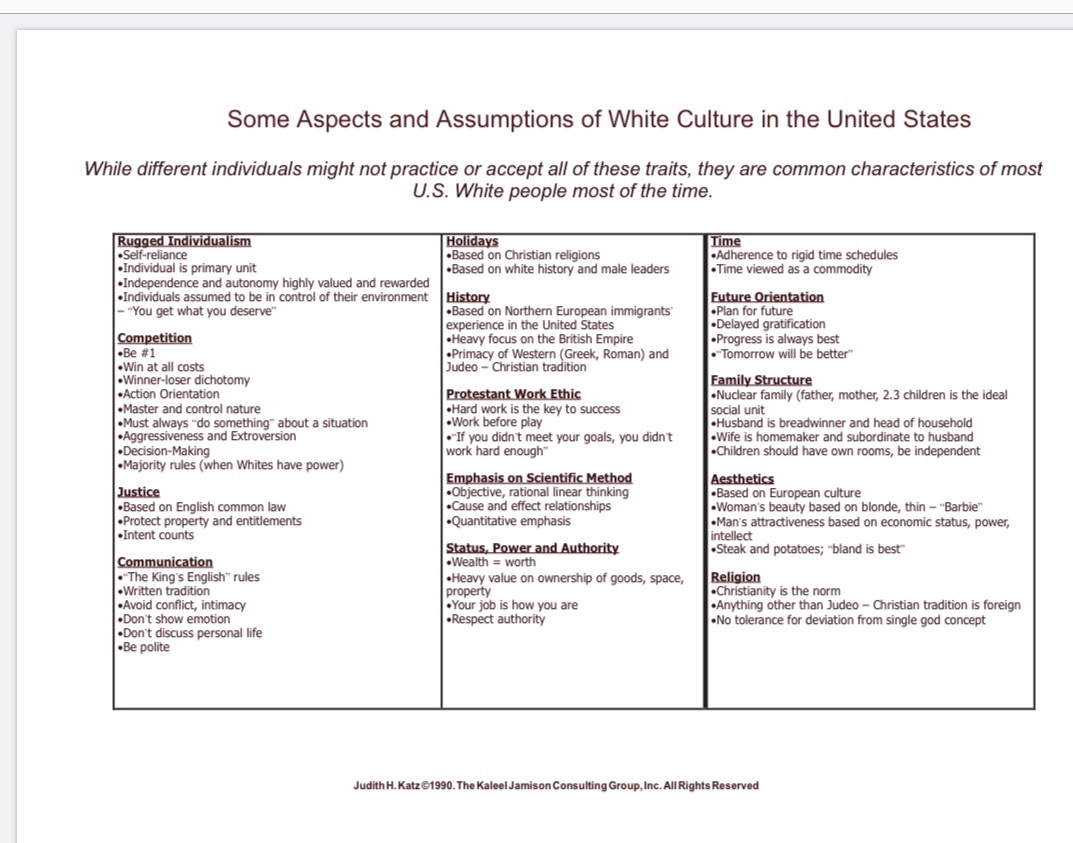
Are we thus saying that people of colour don’t value being self-reliant? Polite? Rational? Hard workers? Planners for the future? Hey, you said it, not me! It is these kinds of overly-simplistic, broad-brushed, negative stereotypes that Critical Race Theory actually accepts, endorses, and promotes that make it an unworthy system of thought.
Math is objective. It is in the very nature of mathematics. And the next time you drive over a bridge or fly in an airplane, I’m willing to bet you’ll be hoping the engineer who designed it believed in objective math, whether they were black or white or anything in between.
Book You Should Buy: Confronting Injustice Without Compromising Truth
Posted on January 27, 2021 1 Comment

I don’t make a lot of book recommendations but I would like to recommend this one for your consideration. Confronting Injustice Without Compromising Truth: 12 Questions Christians Should Ask About Social Justice by Professor Thaddeus Williams is a sound critique of the popular social justice movements from a biblical perspective. He distinguished between what he calls Social Justice A, which is a view of justice founded on Scriptural principles, and Social Justice B, which is founded on secular philosophies. Social Justice B is not only a phenomenon of secular culture, but it is increasingly being adopted by professing believers.
In my estimation, Williams is right that our diagnosis of social problems and our ability to address them rests first on assessing what is true. If we make false assumptions about the nature of truth, justice, inequality, sin, human nature, and the role of the church, then what we call “justice” will inevitably lead to actual injustice. In short, our pursuit of justice (an important biblical mandate) needs to be informed, shaped, and guided by the truth of God’s Word. Otherwise, we go off-course. I thought this book took a well-balanced approach to discussing these distinctions.
One aspect that makes this work unique is the inclusion of personal stories from twelve other contributors. Each one shares their experience of having a warped view of social justice originally to embracing a healthy and healing version that is shaped by the gospel. These stories add a personal element to the work that helps drive home the point that issues of social justice aren’t theoretical. They affect real people in the real world in real ways, for better or worse.
Here are some teaser quotes from the book. Consider purchasing a copy and digging in for yourself.
The problem is not with the quest for social justice. The problem is what happens when that quest is undertaken from a framework that is not compatible with the Bible. Today many Christians accept conclusions that are generated from [worldviews] with very different presuppositions about reality than those we find in Scripture. We shirk God’s commands and hurt his image-bearers when we unwittingly allow unbiblical worldview assumptions to shape our approach to justice.
The doctrine of human depravity swings like a wrecking ball, leveling any ideology that says, “My gender group, my ethnic group, my economic group makes me good, and their group is evil.”
Paul told the truth that being “in Christ Jesus” is a new identity that transcends other group identities.
Here are some clues that we may have been taken in by an anti-Spirit ideology: Instead of being love-filled, we’re easily offended, ever suspicious, and preoccupied with our own feelings. Instead of being filled with joy, we’re filled with rage and resentment, unable to forgive. Instead of striving for peace, we’re quarrelsome—dividing people into oppressed or oppressor groups instead of appreciating the image-bearer before us. Instead of having patience, we’re quickly triggered and slow to honestly weigh our opponents’ perspectives. Instead of being kind, we’re quick to trash others, assuming the worst of their motives. Instead of showing gentleness, we use condemning rhetoric and redefined words to intimidate others into our perspective. Instead of showing self-control, we blame our issues exclusively on others and their systems, not warring daily against the evil in our own hearts.
When we automatically assume damning explanations for unequal outcomes, we not only lock ourselves in a prison of never-ending rage but also dull our senses to the point that we will be useless for the sacred task of recognizing and resisting the real racism, real sexism, and other real vicious isms around us.
…if we don’t bother to distinguish between inequalities that come from sin and those that don’t, then we are well on our way not to a fictional dystopia but to repeating the bloodiest mistakes of modern history.
How would Christians ever show the tribalized world what real unity looks like if they got swept up in such a never-ending game of grievances—treating one another as exemplars of their ethnic groups rather than their shared identity in Christ?
The Tribes mindset trashes not only any meaningful relationship with that person but also any hope of meaningfully thinking about that person’s perspective. In short, it makes us both closed-hearted and closed-minded.
If we care about ending actual sexism, then we should welcome the question of how much of the gender pay gap can be laid at the feet of actual sexism. Otherwise, we aren’t fighting the real problem, but shadowboxing our own ideological projections. The extent to which we shadowbox our ideological projections of the problem is the extent to which we trivialize the victims of real sexism and racism. By diverting our finite injustice-fighting energies in every direction all at once, Tribes thinking unintentionally marginalizes the already marginalized.
…caring about justice requires a commitment to truth. We can no more separate truth from justice than we can subtract one side from a triangle and still consider it a triangle. The extent to which Tribes thinking predetermines answers to hard questions is the extent to which it obscures truth and unintentionally leaves more people broken.
Given the political polarization of our day, seeing our side as caring about others and the other side as cruel is easy and self-serving. But it is not so black-and-white. Often the left and right simply have different “others.” If we are shaped by Scripture instead of the culture wars, then we will not become the priests and Levites galloping past bodies on the side of the road. Christians should be known less as culture warriors and more as Good Samaritans who stop for battered neighbors, whether they are black, white, brown, male, female, gay, straight, rich, poor, old, young, Muslim, Christian, Jewish, atheist, capitalist, socialist, Republican, Democrat, near, far, tall, short, or smaller than a peanut.
There is often a big difference between feelings and facts, between lived experience and objective reality. That difference matters, and we should take both seriously if we want our quest for justice to lead to real justice.
Do arguments magically become true or false by putting them in someone else’s mouth? No. Writing off someone’s viewpoint because of their melanin levels makes us actual racists. Dismissing someone’s argument because of their gender makes us actual sexists. Silencing someone’s ideas because of their sexuality, their economic status, or any other quality of their lives rather than the quality of their ideas does not make us a voice of justice for the marginalized; it makes us actual bigots.
By downplaying the depth of human corruption, socialism becomes a counterfeit gospel. It relies on corrupt human authorities with no room for God’s heart-regenerating grace. Socialism seeks Christ’s kingdom, minus the Christ, and becomes a destructive parody of God’s shalom. The harder it tries to create heaven on earth, the more hell it unleashes, particularly on the poor whom Scripture commands us to love.
Gender distinctions are a gift from God to be celebrated, not obliterated. Men can’t simply replace women, or women replace men, without something exceedingly beautiful being lost. When we get swept up in Social Justice B, our understanding of sexuality comes less and less from Scripture and more and more from the ideological architects and ancestors of the sexual revolution.
Notice that “the gospel” is “of first importance.” And what is that gospel? It is the good news of free salvation by trusting in the sin-atoning death and bodily resurrection of Jesus. It shouldn’t surprise us that Paul understands the gospel this way, since he received it directly from Jesus. Unlike toppling social and economic systems through social activism, this good news of salvation by grace through faith in Christ is what Jesus proclaims to poor in the red letters. It is what the earliest missionaries declare with astonishing saving results throughout the book of Acts. It is the same good news declared throughout the New Testament epistles.
On Censorship
Posted on January 23, 2021 1 Comment

It is no secret that social media platforms have taken serious steps in recent days to censor certain individuals. Then-president Donald Trump was the most obvious example, but since many others have complained of their accounts being deleted or warned by Facebook, Twitter, and others, for going against “community guidelines”. Of course, there is usually little or no explanation concerning what guidelines were broken specifically. In response, hundreds of thousands began to transition over to self-proclaimed free-speech app Parler, only to have both Google and Apple block it from their app stores, as well as Amazon remove it from their hosting servers, effectively scrubbing Parler from the internet.
Think long and hard about what this means. Many have claimed “these are private companies, so they can do whatever they want”. This is only partly true. Even private companies have some limitation for what they can choose to do under American law. But even if they are not breaking the law in these actions, it should be very concerning to people that a handful of companies effectively have the power to completely remove certain voices from the internet. Effectively, if Google, Apple, Amazon, and Twitter decide they want to shut down a particular viewpoint, they can do so in less than one day. That is a freakish amount of global power for only a few individuals to yield.
Again, many push back. “We’re talking about Trump here,” they proclaim, “and he tried to pull off a coup at the Capitol!” While this claim is debatable in and of itself, that is entirely to miss the point. Even if you feel social media should censor people for legitimate reasons…what happens when they begin to do so for illegitimate reasons? What is to stop them?
I myself have been temporarily banned from Facebook and Instagram for sharing blogs from the website you are currently reading. No reason was ever given as to why. I protested, asking for a reason, without ever getting a reply. Suddenly, and without explanation, I was reinstated a few weeks later. To this day I have no idea what I said that supposedly violated “community guidelines”, but I can assure you it had nothing to do with Qanon, election stealing, or any other currently acceptable reason.
I know many Christians who applauded the censoring of Trump and his followers. I can understand why, but I also would want to give them a grave warning: don’t cheer too loudly, because you will be next. Think about it. Satan, the god of this world, wants more than anything to silence the truth, censor the gospel, and control public conversation away from Scriptural ideals. The enemy is not social media giants themselves, but they can and will be used as tools for the enemy in spiritual warfare. This effort will not succeed in the long run, of course. We know God wins in the end. But it absolutely will be effective in the short-term, and make life more difficult for believers in the public square.
The Canadian government is currently doing its own social media crackdown. Trudeau has promised to clamp down on “offensive content and hate speech”, which includes “racist, anti-Semitic, Islamophobic, misogynist and homophobic views”. This may sound good—who would want those ideas promoted?—but keep in mind that the government does not understand Christian doctrine. Many biblical ideas can easily be construed to fit any one of those categories; indeed, the secular world claims that they do already. It is really not that hard to see that in the very near future churches will have their online services blocked, Christians removed from social media, and perhaps even Bible apps taken down under the guise of “hate speech”. None of this spells the end for the Church, but it will create a climate where following Jesus may go from being merely culturally odd to potentially inviting serious legal issues.
Free speech is an important value. It is not only important from a legal perspective, but also from a biblical one as well. Consider a few examples:
- Proverbs 18:17 “The one who states his case first seems right, until the other comes and examines him.” Part of discovering the truth comes from the free exchange of ideas. If we only hear one side of things and the other is censored, it is easier to be deceived.
- Proverbs 27:17 “Iron sharpens iron, and one man sharpens another.” Similarly, our understanding and growth becomes “sharpened” in part by being challenged by others. This includes their ideas.
- Matthew 7:12 “So whatever you wish that others would do to you, do also to them, for this is the Law and the Prophets.” The Christian Golden Rule also applies to speech. If you do not wish to be censored, then you should not be keen to censor others.
- Acts 17:16-34 In this passage, Paul had the freedom to proclaim the gospel in public because the culture of Athens welcomed the sharing of new ideas.
None of this is to argue that censorship is wrong in every circumstance. Things like explicit calls to violence or communication for illegal activity, such as human trafficking, are examples that come to mind where censorship is commended. But what we are seeing is more than that. We are seeing the squelching of ideas that don’t align with the status quo. As Christians, we ought to know that our ideas of truth fit that category. The Bible itself says that the gospel is offensive to the unbelieving world (Galatians 5:11). Christian doctrines like the existence of a Creator, moral standards for sexuality, distinction between men and women, damnation, and salvation through Christ alone are more than ancient relics of the past. They are unacceptable hinderances to an increasingly secular humanist future. Censorship is inevitable.
Our strategy for Christian ministry will need to adapt. In Ontario, where I live, lockdowns because of the coronavirus have forced churches to go online with their ministries. This works for the time being. But perhaps the online world will not be so welcoming for long. I seriously wonder if the typical North American style of church is a sustainable model for the future. My guess is that believers here will have to increasingly find other methods of effective Christian ministry. While Satan may mean this for evil, God means it for good. Perhaps this is the way our Lord is purging our churches of lukewarm faith, dulled desire for evangelism, and apathetic worship.
Jesus reminds us that anyone who desires to follow him must first count the cost. For many of us, that cost has been relatively minimal. Maybe that will change in the future. Only God knows for sure. Either way, it is a good reminder for us to get our hearts right before the Lord, re-establish ourselves as citizens of heaven free from the love of this world, and be prepared to meet any trials that may come with joy (James 1:2-4).
 Canadian Bible Guy